III · THE WORK · ART HISTORY
An Experiment on a Bird in the Air Pump
▶ Listen · narrated
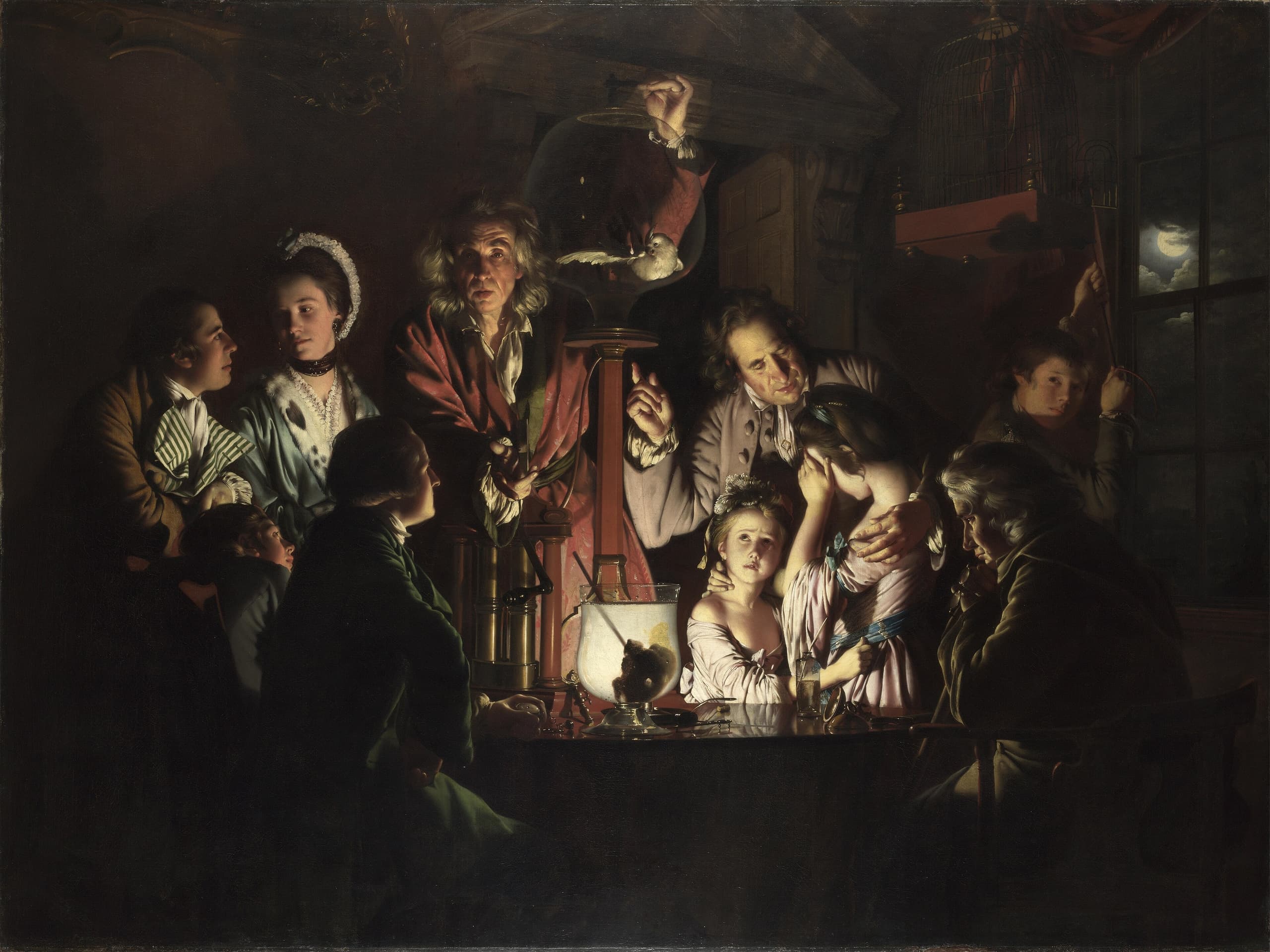
A natural philosopher stands over an air pump; a bird loses its air. Around him, faces split between curiosity and distress. The canvas asks where you stand among them.
At a glance
- Artist
- Joseph Wright of Derby
- Date
- 1768
- Medium
- Oil paint on canvas
- Size
- 483 × 586 mm (23.07 in)
- Collection
- National Gallery, London
- Inventory
- NG725
Look closer
The figure who turns outward
At the centre stands the natural philosopher, hand on the apparatus, body angled toward the company yet face directed past them. He looks out of the picture as if the decision about the bird were somehow shared with whoever stands in front of the canvas. That outward gaze is the hinge of the composition: the experiment is not closed inside the room; it is staged as a question put to the viewer.
Light as argument
The scene is lit as if by a single strong source, the kind of artificial light Wright used across several candlelit pictures of the 1760s. Faces and hands catch hard edges of brightness; the rest falls into deep shadow. The glass vessel and the bird inside it sit in that concentrated light, so that the instrument of the experiment becomes the brightest object after the human faces. The lighting does not merely describe a room at night. It ranks what matters.
A circle that will not agree
Around the pump the onlookers do not form a single mood. Some lean in with what reads as scientific curiosity; others show grief, disbelief or dismay. The variety is deliberate and visible: no one reaction is allowed to dominate the group. Concern for the bird and interest in the demonstration occupy the same table. The painting holds both without resolving which ought to win.
The story
Joseph Wright of Derby painted An Experiment on a Bird in the Air Pump in 1768, in oil on canvas. The picture is modest in size — 483 by 586 millimetres (23.07 in) — yet it is built like a history painting: a full company arranged around a decisive action, faces lit to register feeling, a central figure who seems to know the viewer is there.
What is being shown is a recreation of one of Robert Boyle’s air-pump experiments. A natural philosopher, forerunner of the modern scientist, has placed a bird inside a glass vessel and is withdrawing the air. The bird’s fate hangs on whether the operator restores the air in time. That uncertainty is not hidden in the background. It is the subject.
Wright belonged to a moment when scientific demonstration was a form of public theatre as well as inquiry. He painted several candlelit scenes in the 1760s, and this one takes the apparatus of natural philosophy — pump, glass, living subject — and sets it with the solemnity once kept for religious or historical narrative. The departure from convention is quiet but clear. No saint, no battle, no coronation. A bird, a machine, and a roomful of people who cannot agree what they are watching.
The composition arranges the company so that reaction becomes content. Curiosity presses forward; distress turns aside; the central figure holds the stopcock and the gaze. Because he looks out, the experiment is not only happening in 1768. It is happening wherever the picture is seen. The viewer is enrolled among the onlookers without being told which side of the table to take.
Wright was closely involved in depicting the Industrial Revolution and the scientific advances of the Enlightenment. His contemporaries recognised the pictures as exceptional, yet his provincial standing and his choice of subjects meant the manner was not widely taken up. The canvas later entered the National Gallery, where it remains (inventory NG725). It has been classed as genre art and associated with Romanticism, labels that sit a little awkwardly on a work so intent on a specific modern practice — the public experiment — rather than on landscape mood or rustic anecdote.
Nothing in the paint settles the outcome for the bird. That refusal is part of the design. The picture stops at the instant when knowledge and pity are both still possible, and leaves the company, and the person standing before the frame, inside that pause.
Why it mattered then
In the 1760s a scientific demonstration could still be staged as a social evening. Air pumps after Boyle were familiar enough to educated audiences to be recognised, yet dramatic enough to hold a room. Wright’s decision to treat such a scene with the scale of attention usually given to scripture or history was a claim about what deserved seriousness. Enlightenment inquiry was not only a matter of instruments and results; it was a matter of how people looked, flinched, and chose. By gathering grief and curiosity into one lit circle, the painting recorded a culture learning to watch nature under glass — and not yet agreed on the cost of the lesson.
Why it matters now
The picture still works because the split it shows has not gone away. Public science continues to ask audiences to accept procedures that harm or risk a living subject in the name of knowledge. Wright does not sermonise. He simply refuses to let one reaction cancel the others. Standing before the canvas, a modern viewer is put in the same mixed company: drawn to the apparatus, unsettled by the bird, addressed by the operator’s outward look. The painting remains a precise account of how demonstration makes spectators complicit, whether or not they asked to be.
The surprising detail
For a work so often treated as monumental in feeling, the canvas itself is small — under half a metre high. Wright packed a full theatrical company, a complex machine, and a moral standoff into a surface closer to a cabinet picture than to a grand gallery machine. The intimacy of the scale sharpens the address: the central figure’s look out of the frame meets you at conversational distance, not across a vast hall.
What is disputed
Wikidata lists the genre as genre art and the movement as Romanticism; both labels are retrospective and sit loosely on a picture so closely tied to Enlightenment demonstration. Contemporaries recognised Wright’s work as exceptional, but the claim that the style was never widely imitated reflects his provincial position and subject matter rather than a single documented rejection. The precise emotional reading of each onlooker is interpretive; the painting shows variety, not labelled feelings.
Remember this
Wright gives a bird in an air pump the solemn attention once kept for sacred history, and leaves the viewer among a company that cannot agree what it is seeing.
Test yourself
The central figure looks out of the painting rather than only at the bird or the company. What does that single choice do to the viewer’s position?
It stops the viewer being a safe outsider. By meeting the gaze of the man who controls the pump, the person in front of the canvas is treated as part of the circle that must live with the outcome. The experiment is no longer only a scene observed; it becomes a situation in which the viewer has been silently enrolled, without being told whether to side with curiosity or with pity.
Go deeper
- An Experiment on a Bird in the Air Pump · Wikipedia
- An Experiment on a Bird in the Air Pump — Wikidata · Wikidata
Image: Joseph Wright of Derby, Public domain. Licence: Public domain. Source.