III · THE WORK · ART HISTORY
The Concert
▶ Listen · narrated
Vermeer painted a man and two women at music in 1663. The canvas left his world for a Boston museum, then left that museum too — and has not been seen since.
At a glance
- Artist
- Johannes Vermeer
- Date
- 1663
- Medium
- Oil on canvas
- Dimensions
- 72.5 × 64.7 cm (2 ft 1 in)
- Collection
- Isabella Stewart Gardner Museum
- Genre
- Genre art
Look closer
Three at music
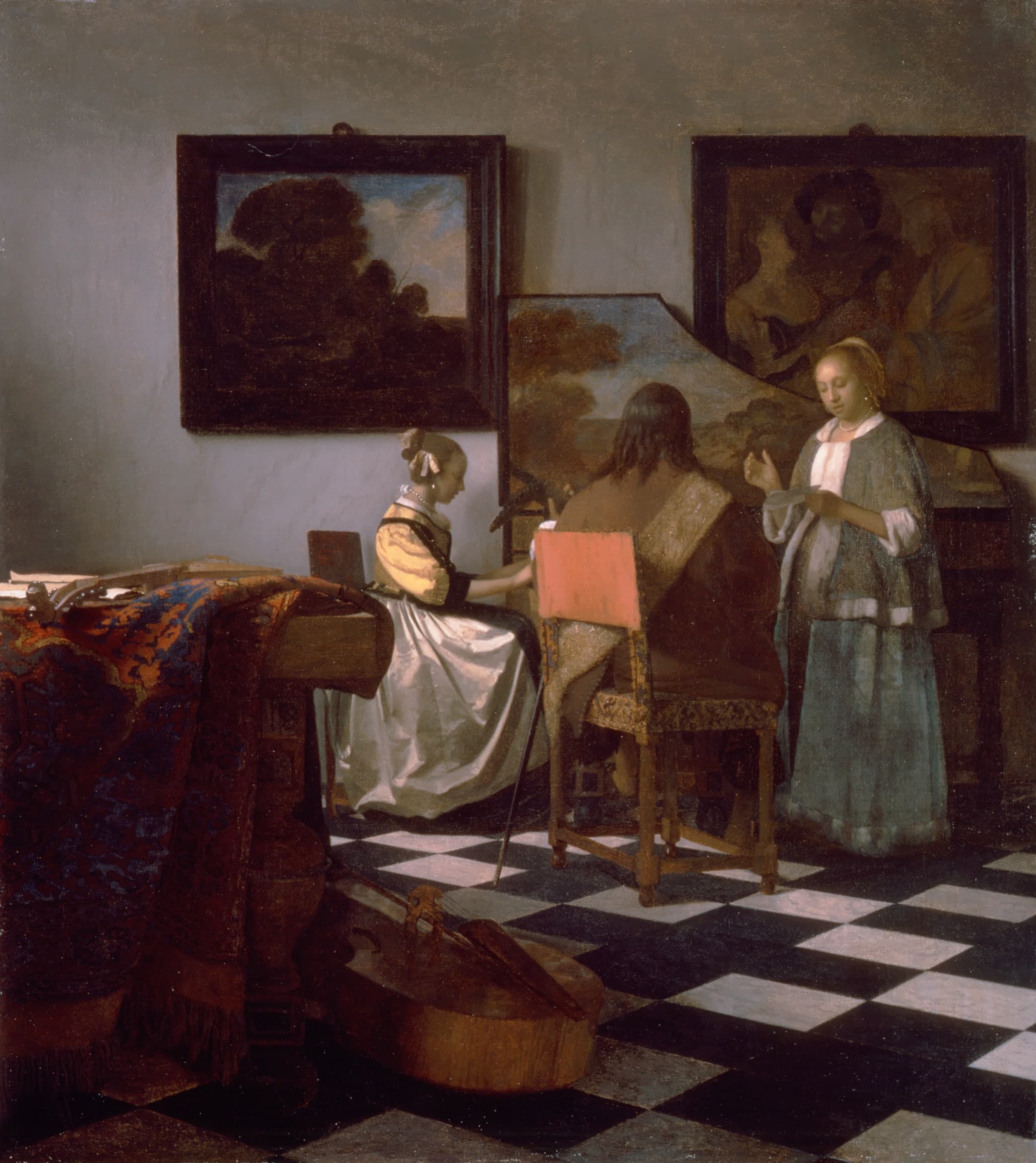
The painting shows a man and two women performing music. That is the whole of the recorded subject: a domestic genre scene built around a single activity. Vermeer has given the canvas over to the act of playing together, without any further narrative supplied by the title or the documented description. What we know of the composition begins and ends with those three figures and the music they share.
A compact canvas
The work measures 72.5 centimetres (2 ft 5 in) high by 64.7 centimetres (2 ft 1 in) wide — a modest interior rather than a grand public statement. Oil paint on that scale draws the viewer in close. The dimensions suit a private room and a private subject: people making music for one another, not for a crowd.
Still on the books
The painting belongs to the Isabella Stewart Gardner Museum and carries the inventory number P21w27. It is not on the wall. Stolen on 18 March 1990, it remains missing. Close looking at The Concert is now, by necessity, close looking at records, dimensions, and the fact of its absence from the collection that still claims it.
The story
Johannes Vermeer painted The Concert in 1663. The work is oil on canvas, 72.5 centimetres (2 ft 5 in) high and 64.7 centimetres (2 ft 1 in) wide. It belongs to Dutch Golden Age painting and to the category of genre art: a scene of ordinary activity rather than history, portrait, or myth.
What the painting shows is straightforward to state and hard, now, to see. A man and two women perform music. That is the subject as it has come down in the record used here. The three figures share a room and a task. Nothing in that record adds a named instrument, a secondary story, or a known patron. The picture is a small interior given over to the act of making music together.
The canvas entered the collection of the Isabella Stewart Gardner Museum in Boston, where it was inventoried as P21w27. It remained there until 18 March 1990, when it was stolen. It has not been recovered. The museum still holds the work in its catalogue and still names the painting as part of its collection. The object itself is elsewhere, or destroyed, or hidden. No public fact in the sources at hand settles which.
Close looking, under those conditions, changes character. The dimensions remain exact. The materials remain oil paint and canvas. The attribution to Vermeer stands in the record. What disappears is the surface on which the looking would once have happened — the particular arrangement of three figures at music in a room Vermeer set down and we can no longer enter. Descriptions and the catalogue entry stand in. They are not the painting.
The Concert therefore sits in two states at once. It is a finished work of 1663, a genre scene of modest size by a painter of the Dutch Golden Age. It is also a missing object, taken from a Boston museum more than three centuries later and not returned. Both facts are true. Neither cancels the other. To study the composition is to work inside that tension: between what the painting was made to be and the thin channel of evidence through which it can still be reached.
Why it mattered then
In the Dutch Golden Age, genre painting made a serious subject of ordinary rooms and ordinary acts. A man and two women at music belonged to that taste: private life rendered with care on a domestic scale. Vermeer’s canvas, at under three-quarters of a metre high, was sized for a close viewer and a private wall. Oil on canvas of those dimensions could hold a quiet scene without demanding a public hall. The painting’s first meaning sat inside that culture of looking — at interiors, at shared tasks, and at music as something people did together in a room.
Why it matters now
The Concert still matters because it forces a question about where a painting’s life resides. The Isabella Stewart Gardner Museum continues to list it; the inventory number P21w27 still points to a work by Vermeer of 1663. Yet the object has been missing since 1990. Anyone who wants to look closely must now do so through absence: through dimensions, materials, genre, and the spare description of three musicians. That is a different kind of attention from standing before the canvas. It is also, for this work, the only kind left. The theft did not erase the painting from the record. It changed the terms on which the record can still be read.
The surprising detail
The Concert was stolen from the Isabella Stewart Gardner Museum on 18 March 1990 and remains missing. A Vermeer of known size, materials, and subject left the building and has not come back. The museum still names the work in its collection. The canvas does not hang there. Few paintings of this date have a documentary life that breaks off so sharply in the modern record while the catalogue entry stays open.
What is disputed
The date is given here as 1663 from the catalogue data; other accounts place the work around 1664. Beyond the presence of a man and two women performing music, the detailed contents of the composition are not supplied in the sources used for this lesson and should not be filled in from memory or habit.
Remember this
The Concert is a 1663 Vermeer of three musicians — still in the Gardner catalogue, still missing since 1990.
Test yourself
The painting is both firmly catalogued and wholly absent. What does that double status change about how we can look at its composition?
It means that any close looking must work from what the record securely gives — a man and two women performing music, on a canvas 72.5 by 64.7 centimetres (2 ft 1 in), in oil — rather than from a surface we can stand before. The composition is not erased, but it is mediated. We study a genre scene whose details beyond the three musicians are thinner in the surviving description than we might wish, and we do so knowing the original paint is out of reach. The looking becomes an exercise in the limits of evidence as much as in Vermeer’s arrangement of figures.
Go deeper
Image: Johannes Vermeer, Public domain. Licence: Public domain. Source.