I · THE OBJECT · BRITISH MUSEUM
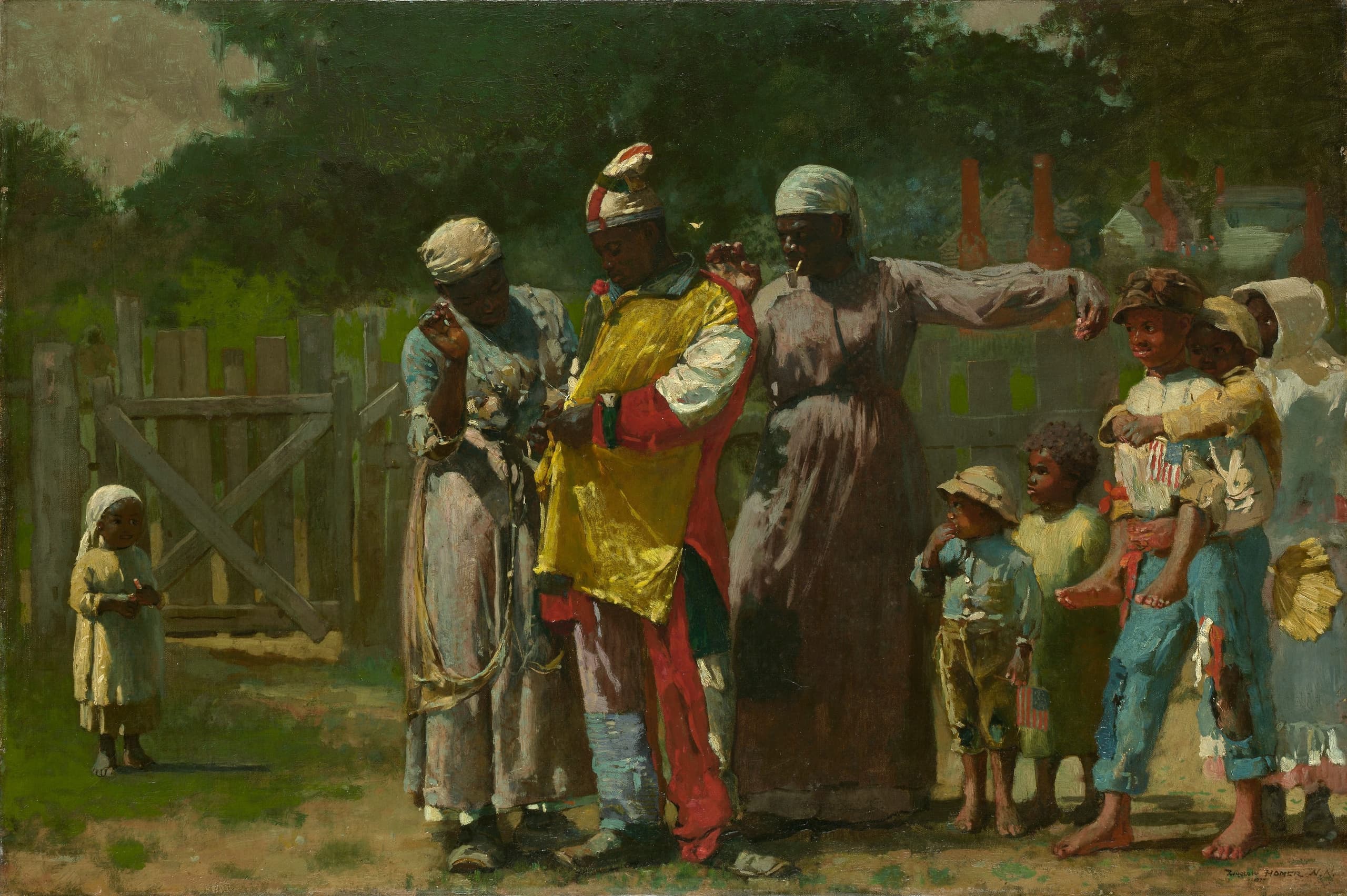
Dressing for the Carnival
▶ Listen · narrated
The facts that survive for this picture are few: who painted it, when, in what medium, and where it hangs. That spareness is itself worth sitting with.
At a glance
- Date
- 1877
- Artist
- Winslow Homer
- Material
- Oil paint on canvas
- Dimensions
- 50.8 × 76.2 cm (2 ft 6 in)
- Genre
- Genre art
- Inventory
- 22.220
Look closer
Oil on canvas, plainly stated
The support is canvas; the medium is oil paint. Nothing in the recorded facts elaborates the ground, the varnish, or later interventions. What can be said with certainty is the combination itself: a portable fabric support carrying oil colour, the standard studio means for an easel picture of this date in the United States.
A measured rectangle
The painting is 50.8 centimetres (1 ft 8 in) high and 76.2 centimetres (2 ft 6 in) wide. That proportion is wider than it is tall, a landscape-oriented format even if the subject is peopled. The scale is intimate rather than mural: a work meant to be met at close range, not across a hall.
Filed as genre art
The work is classed as genre art — scenes of everyday life rather than history, portraiture, or pure landscape. The label does not tell us which everyday moment Homer chose, only that the picture was understood, and is still catalogued, inside that tradition.
The story
Dressing for the Carnival is an oil painting on canvas by the American painter Winslow Homer. It dates from 1877. It belongs to the Metropolitan Museum of Art in New York, where it is kept under the inventory number 22.220, and it is recorded as a work of genre art made in the United States.
Those are the secure facts. The canvas measures 50.8 centimetres (1 ft 8 in) in height and 76.2 centimetres (2 ft 6 in) in width. The materials are oil paint and canvas. Beyond that bare catalogue entry, the supplied record does not describe the figures, the setting, the colours, or the precise occasion Homer painted. It does not say how the picture moved from the studio into the museum, nor what critics wrote when it was new.
What remains is still enough to place the object. Homer was working in oil on a modest rectangular support in the late 1870s, and the finished picture was later judged to belong with genre painting — the branch of art that takes ordinary social life as its subject rather than myth, scripture, or formal likeness. The title names a carnival and the act of dressing for it; the museum classification groups the work with scenes of daily and festive custom. How far the painted surface matches the expectations those words raise is a question the sparse record cannot answer here.
The picture’s present home is unambiguous. It is in the collection of the Metropolitan Museum of Art and is located there. For a lesson built only on verified catalogue data, that chain — maker, date, medium, dimensions, genre, country, inventory number, and institution — is the whole armature. Everything else would be invention.
Why it mattered then
In 1877 an American painter finished an oil on canvas and set it within the reach of genre art. Genre painting already had a long European history as a way of giving serious attention to ordinary and festive life; by the later nineteenth century it was also a living category in the United States. A work so classed asked to be read as observation of social habit rather than as allegory or commissioned portrait. The date alone fixes Homer’s picture inside that moment, when oil on canvas remained the ordinary vehicle for such subjects and when museums and collectors were building holdings of contemporary American painting. Without further contemporary testimony in the record used here, one cannot press harder on reception or intent. The secure claim is simply that the picture was made then, in that medium, under that generic heading.
Why it matters now
It still matters because the object is real, finite, and publicly held. A dated canvas by a named maker, measured and inventoried, sits in the Metropolitan Museum of Art for anyone who goes to look. Catalogues reduce pictures to facts — height, width, medium, number — and those facts are how institutions keep track of what they hold. Returning to them is a way of refusing to embroider. The painting’s continuing presence in a major collection means the 1877 surface remains available for fresh looking, even when a short lesson must admit how little of the surrounding story it is entitled to tell.
The surprising detail
For a picture this well placed in a major museum, the verified public facts used here are strikingly few: maker, year, medium, size, genre, country, inventory number, and location. No acquisition path, no exhibition history, and no description of the painted scene appear in that set. The gap between the fame a museum object can gather and the thinness of its secure data is itself the memorable point.
What is disputed
The verified facts identify the maker, date, materials, dimensions, genre, country of origin, inventory number, and museum location. They do not describe the composition, the figures, the colours, the circumstances of making, or the path by which the picture entered the Metropolitan Museum of Art. Any fuller narrative would require sources beyond those supplied here, and has been omitted on purpose.
Remember this
Winslow Homer, 1877, oil on canvas, 50.8 by 76.2 centimetres (2 ft 6 in), genre art, Metropolitan Museum of Art, 22.220 — and no further claim without further evidence.
Test yourself
The work is catalogued as genre art. What does that classification claim about the picture, and what does it leave unsettleable from the facts alone?
Genre art names a tradition of subjects drawn from everyday and social life rather than from history, religion, or formal portraiture. The classification tells us how the painting has been typed; it does not, by itself, describe which moment of daily or festive life Homer showed, how the figures are arranged, or how viewers in 1877 received the scene. Type is not the same as a full account of content.
Go deeper
Image: Winslow Homer, Public domain. Licence: Public domain. Source.