II · THE DISCOVERY · HISTORY OF SCIENCE
Photon
The idea that light comes in discrete packets rather than continuous waves changed how physicists understand energy, matter, and the forces that govern them.
At a glance
- What it is
- A type of quantum particle
- Discovery date
- 1923
- Mass
- Massless
- Speed
- The speed of light in a vacuum, always
- Named from
- Ancient Greek phôs, meaning light
Look closer
Wave and particle at once
Photons exhibit wave–particle duality — their behaviour shows properties of both waves and particles. This is not a metaphor or a pedagogical compromise: the same entity diffracts like a wave through a slit and registers like a particle on a detector. Quantum mechanics describes this, but the photon remains the clearest example of something that refuses the categories classical physics offers.
Only one speed
Photons are massless and can move at only one speed: the speed of light measured in a vacuum. They do not accelerate or decelerate. A photon emitted from a distant star and one from a torch in your hand both travel at exactly the same speed. This is a consequence of having no mass, and it makes the photon the carrier of the electromagnetic force across space.
Energy in discrete units
The photon concept rests on the idea that light itself is made of discrete units of energy, not a continuous flow. Max Planck proposed that energy stored in matter should be regarded as composed of an integer number of equal-sized parts. Albert Einstein extended this to light itself, introducing the idea that electromagnetic radiation comes in packets. Gilbert N. Lewis gave those packets the name photon in 1926.
The story
A photon is an elementary particle — one of the basic constituents of the physical world that cannot be broken into smaller parts. It is a quantum of the electromagnetic field, meaning it is the smallest possible unit of electromagnetic radiation. Light, radio waves, X-rays, and all other forms of electromagnetic radiation are made of photons.
The modern photon concept originated during the first two decades of the twentieth century. Max Planck was trying to explain how matter and electromagnetic radiation could be in thermal equilibrium — how they could exchange energy without one heating up or cooling down relative to the other. He proposed that the energy stored within a material object should be regarded as composed of an integer number of discrete, equal-sized parts, not as a continuous quantity that could be divided infinitely.
Albert Einstein built on Planck's work. To explain the photoelectric effect — the observation that light shining on certain metals causes them to emit electrons — Einstein introduced the idea that light itself is made of discrete units of energy, not a continuous wave. Each unit carries a specific amount of energy, and when one strikes an electron in the metal, it can knock the electron loose. The effect depends on the energy of each unit, not on the brightness of the light overall, which is why dim ultraviolet light can cause the effect while bright red light cannot.
Gilbert N. Lewis popularized the term photon for these energy units in 1926. The discovery date recorded is 1923, though the concept developed over the first decades of the twentieth century and many experiments validated Einstein's approach after he proposed it.
Photons belong to the class of particles called bosons. In the Standard Model of particle physics, photons and other elementary particles are described as a necessary consequence of physical laws having a certain symmetry at every point in spacetime — the intrinsic properties of particles, such as charge, mass, and spin, are determined by what is called gauge symmetry. The photon is the force carrier for the electromagnetic force, meaning it is the particle exchanged when electrically charged particles interact with one another.
Photons are massless, and this has a direct consequence: they can only move at one speed, the speed of light measured in a vacuum. They do not slow down or speed up. A photon exists at that speed or it does not exist at all.
Why it mattered then
Before the photon concept, physicists understood light as a wave and had experimental evidence for that view — light diffracts, refracts, and interferes in ways waves do. The photoelectric effect could not be explained by wave theory alone. Einstein's proposal that light is made of discrete packets of energy, each carrying a specific quantum, allowed the effect to be understood: an electron absorbs one packet, and if that packet carries enough energy, the electron is ejected from the metal. No amount of dim light, however bright overall, will do it if the individual packets are too weak. The photon concept resolved a contradiction. Planck had quantized energy in matter to explain thermal equilibrium; Einstein quantized light itself. The idea was not immediately accepted — it took many experiments over the following years to validate it. But once it was, the implications were large. The behaviour of matter and radiation, the structure of atoms, and the forces between particles all had to be rethought in terms of quanta rather than continuous fields. The photon became the clearest example of wave–particle duality, a central feature of quantum mechanics.
Why it matters now
The photon concept underpins much of modern physics and technology. Lasers rely on stimulated emission of photons — atoms releasing photons in step with one another, producing coherent light. Bose–Einstein condensation, a state of matter at temperatures near absolute zero, was predicted using the statistical behaviour of bosons, the class of particles to which photons belong. Quantum field theory, the framework for describing elementary particles and their interactions, treats photons as excitations of the electromagnetic field. The probabilistic interpretation of quantum mechanics — the idea that we can only predict the probability of finding a photon in a given place, not its exact location — emerged from studying light and matter at the quantum level. Photons are studied as elements of quantum computers, where information is encoded in quantum states that can exist in superposition. They are used in optical imaging and optical communication, including quantum cryptography, where the quantum properties of photons make it possible to detect eavesdropping on a communication channel. The photon concept has been applied to photochemistry — how light drives chemical reactions — and to high-resolution microscopy and measurements of molecular distances. The idea that light is both wave and particle, that it comes in discrete units, and that those units are the force carriers for electromagnetism, is now foundational. It is not an approximation or a model that will be replaced; it is the structure on which much of physics and its applications rest.
The surprising detail
Gilbert N. Lewis, who popularized the term photon in 1926, is better known to chemistry students for Lewis structures — the diagrams showing how atoms share electrons in molecules. He proposed the name photon in a short article, and the term was adopted quickly, but the particle concept itself had been developing for the first decades of the twentieth century by then. The word gave a name to an idea that had already reshaped physics, but it took a chemist to supply it.
What is disputed
The discovery date is recorded as 1923, but the photon concept developed over the first decades of the twentieth century. Max Planck's work on quantized energy in matter began in 1900, Albert Einstein proposed that light itself is quantized in 1905, and Gilbert N. Lewis coined the term photon in 1926. Many experiments validated the concept during those years. The 1923 date may refer to a particular experiment or consensus point, but the concept itself has no single discovery moment.
Remember this
A photon is the smallest unit of light, and of all electromagnetic radiation. It is both wave and particle, and it moves at only one speed.
Test yourself
Why does dim ultraviolet light cause the photoelectric effect — knocking electrons out of metal — while bright red light does not, no matter how intense you make it?
Because each photon of ultraviolet light carries more energy than each photon of red light, and it is the energy of the individual photon that matters, not the total brightness. An electron absorbs one photon at a time. If that photon carries enough energy, the electron is ejected. Red light photons are too weak individually, so adding more of them does not help. This was the observation that led Einstein to propose that light is made of discrete packets of energy, each with a specific quantum, rather than a continuous wave.
Go deeper
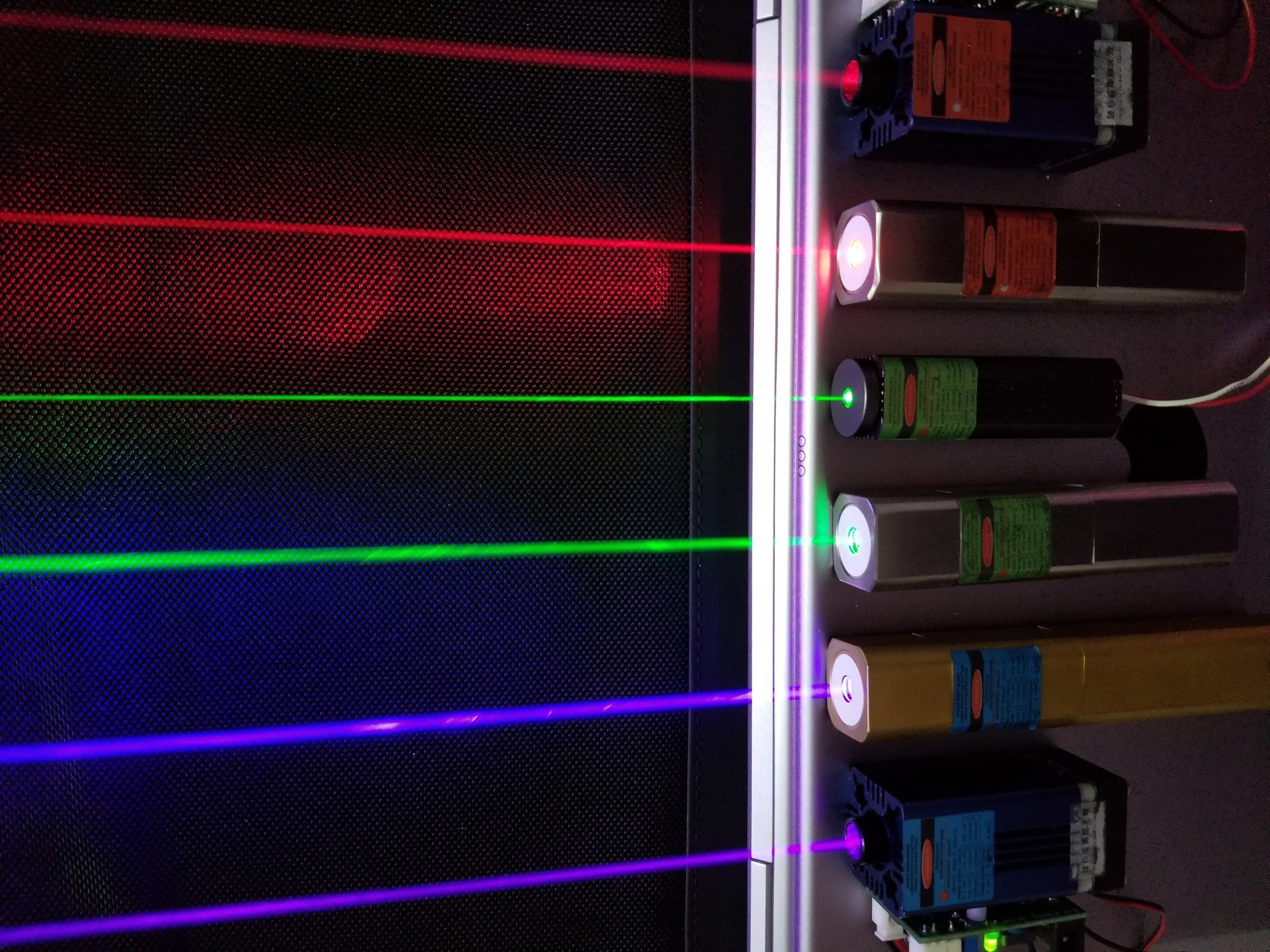
Image: 彭嘉傑 at Chinese Wikipedia. Licence: CC BY-SA 3.0. Source.