III · THE WORK · ART HISTORY
Landscape with the Fall of Icarus
▶ Listen · narrated
You are told this is the fall of Icarus, yet the first solid thing you meet is ordinary work. The painting’s argument lives in that delay of recognition.
At a glance
- Attribution
- Pieter Bruegel the Elder (disputed)
- Medium
- Oil on canvas
- Dimensions
- 73.5 × 111 cm (3 ft 8 in)
- Collection
- Royal Museums of Fine Arts of Belgium
- Location
- Oldmasters Museum
- Genre
- Landscape; mythological painting
Look closer
Labour before legend
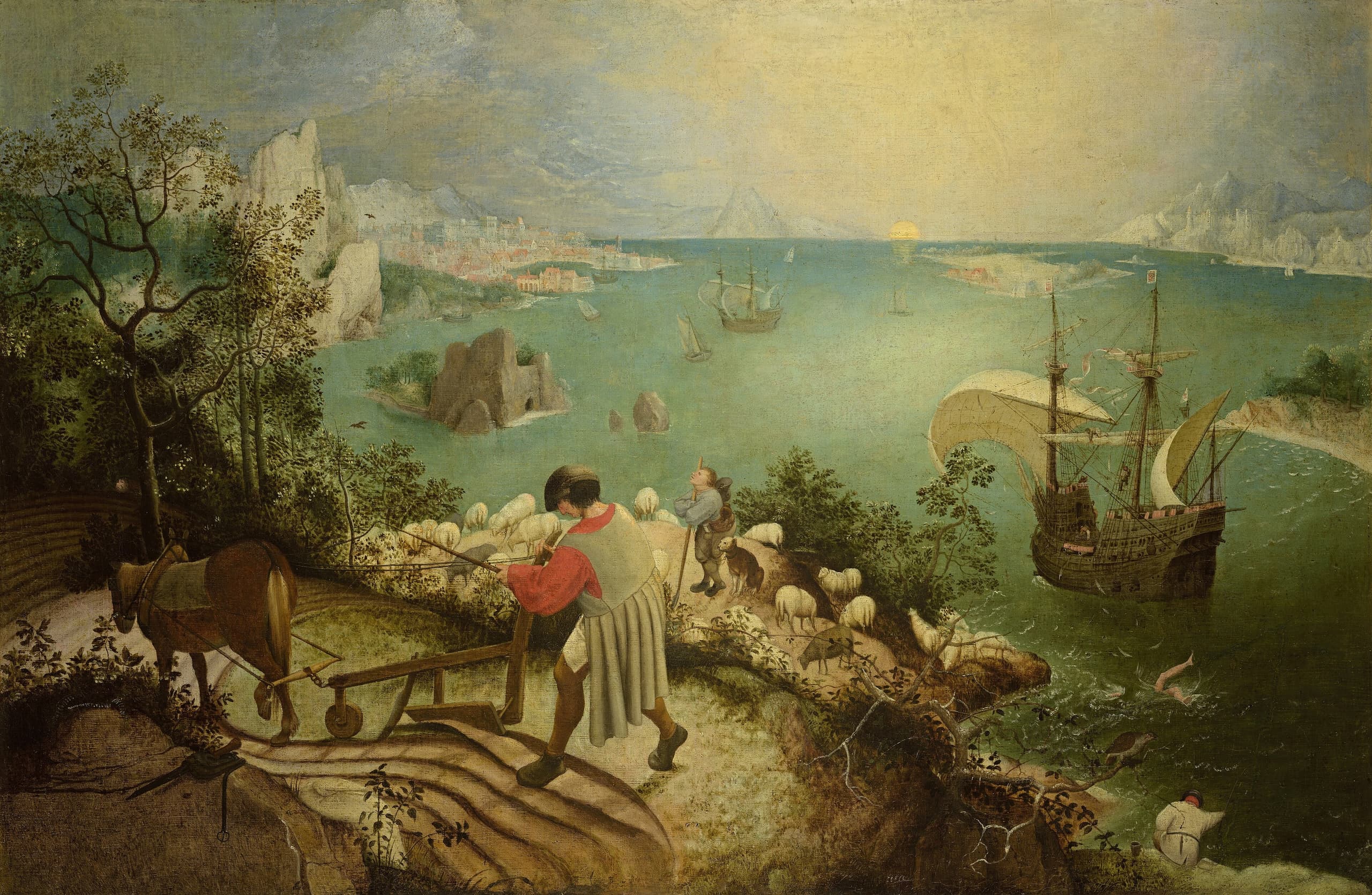
The largest human presence is not the mythic flyer but a man at the plough, set close to us on a sloping field. His body, the horse, and the cut earth take up the kind of pictorial weight usually reserved for heroes. The title subject has been demoted by sheer scale: agriculture claims the foreground; the classical story must wait its turn.
The fall at the margin
Icarus is present only as a pair of legs breaking the surface near the lower right, already past drama and into disappearance. No thrashing torso, no watching crowd. The myth arrives as a small disturbance in busy water, easy to overlook if the title had not sent you hunting for it.
A world laid out in depth
Beyond the field the land drops toward a harbour and a bright expanse of sea, with ships on varied courses and a far coastal profile. The high viewpoint and deep recession belong to the Northern ‘world landscape’ tradition: many small incidents held in one continuous space. Here that breadth makes the drowning feel local, almost private, inside a working day that does not pause.
The story
The canvas measures 73.5 by 111 centimetres (3 ft 8 in) and is painted in oil. What it offers first is not a climax from classical story but a coastal countryside under open sky. A ploughman works the near slope; other figures carry on with the business of a shoreline day. Only after the eye has accepted that order of things does it catch, at the water’s edge, the pale legs of a figure already going under. That figure is Icarus. The painting is built so that recognition comes late.
The design draws on the world landscape type familiar in Early Netherlandish painting: a raised viewpoint, a deep pull from foreground earth to distant sea, and small events scattered through the recession. What is distinctive is the proportion given to an unrelated genre figure at the front. Other landscapes from the same Northern Renaissance world place working people on a raised foreground, yet rarely so large relative to the whole, and rarely with a subject from a ‘higher’ narrative class reduced to a detail behind them. Here the hierarchy of attention is quietly inverted. Myth does not preside. It punctuates.
The story comes from Ovid. Icarus flies on wings bound with wax, climbs too near the sun, and falls when the wax gives way. The familiar moral warns against excessive ambition. This picture does not stage the glory of flight or the instant of terror in mid-air. It stages the world into which the fall drops — ships still under sail, a field still being turned, a coastline indifferent to one swimmer’s fate. The traditional warning is not discarded; it is enforced by scale. Ambition ends as a splash. Useful work keeps its acreage.
Authorship is less firm than the design. The work was long given to Pieter Bruegel the Elder. Technical examination has led many to treat the Brussels painting as a good early copy of a lost original, with the composition held to be his even where the execution is doubted. The museum itself has put that distinction plainly, while more recent technical research has reopened rather than settled the question. The painting remains in the Oldmasters Museum, part of the Royal Museums of Fine Arts of Belgium, inventory number 4030: a Northern Renaissance landscape whose intelligence is clearer than the name on the label.
Read as composition rather than as a secure autograph, the picture is still unusually pointed. It is, on the usual account, Bruegel’s only subject taken from classical mythology, which makes the decision to bury that subject in the margin the more deliberate. The ploughman’s calm is not filler. It is the measure against which the fall is sized.
Why it mattered then
In the sixteenth-century Low Countries, subject matter carried rank. Religious and mythological scenes stood above scenes of daily labour. This composition presses against that order without needing a manifesto. By giving the foreground to agricultural work and confining the Ovidian death to a corner of the sea, it performs what later writers would call a kind of Mannerist inversion — a strategy also visible in contemporary Antwerp pictures that set large kitchen or market figures before a distant sacred episode. The effect is moral as well as formal. Humbler roles, shown as steady and absorbing, occupy the space of importance; overreaching is literally sidelined. If the invention is Bruegel’s, the choice of his sole classical subject for this treatment is part of the meaning: the antique tale is admitted, then refused the centre.
Why it matters now
The painting still trains attention. Viewers arrive with the title and must search for the event it names; that small hunt is not a gimmick but the work’s ethics of looking. Suffering, it suggests, can happen at the edge of someone else’s ordinary afternoon, and the world need not rearrange itself into a theatre. Later poems — among them W. H. Auden’s ‘Musée des Beaux-Arts’, written under the museum’s former name — returned to this disproportion because it remains legible without specialist knowledge. The picture also stays alive as a problem of making and remaking: a composition of clear purpose whose precise hand is still argued over. Standing before it, one looks hard at both a visual argument and the limits of certainty about who painted what we see.
The surprising detail
For a work so firmly tied to Bruegel’s name in public memory, the museum’s own position has been carefully hedged: the execution may well not be his, while the composition can be affirmed as his with far more confidence. That split — invention secure, hand uncertain — is rarer in popular accounts than in the label. The painting that taught generations how Bruegel thought about myth may be the thoughtful echo of a lost original rather than the original itself, and recent technical work has kept even that cautious formula from hardening into final fact.
What is disputed
Attribution is genuinely unresolved and should stay that way in the prose. The work was long given to Pieter Bruegel the Elder; after technical examination many scholars have regarded the Brussels painting as a good early copy of a lost original, while the museum has distinguished a composition that can be called his from an execution that may not be. Recent technical research has reopened the question. Dates for the lost original and for this canvas are accordingly tentative; the verified record does not fix a secure year.
Remember this
Icarus is in the title; the plough claims the frame. The painting’s meaning is the gap between those two facts.
Test yourself
Why does placing a large agricultural figure in the foreground, while reducing Icarus to a small detail, change the moral force of the myth rather than simply illustrating it?
Because the traditional warning against overreaching is enforced by pictorial priority, not by a central spectacle of the fall. Labour occupies the space of importance; ambition becomes a brief disturbance at the margin of a continuing day. The viewer’s delayed recognition mimes the world’s indifference: we, like the figures in the field, almost miss the drowning. The hierarchy of genres is inverted so that the ‘low’ subject measures the ‘high’ one, and the moral is felt as scale and attention rather than as a caption.
Go deeper
- Landscape with the Fall of Icarus · Wikipedia
- Landscape with the Fall of Icarus — Wikidata · Wikidata
Image: After Miep Gies, Public domain. Licence: Public domain. Source.