II · THE DISCOVERY · HISTORY OF SCIENCE
Transformer
The transformer is what allows electrical power to travel hundreds of miles from a generating station to your home, stepping voltage up for transmission and down for use.
At a glance
- Discovered
- 1831
- Discoverer
- Michael Faraday
- Type
- Passive electronic component
- Function
- Transfers electrical energy between circuits
Look closer
No metallic connection required
The defining feature of a transformer is that it moves electrical energy from one circuit to another without any conductive wire linking the two. The energy crosses the gap through a changing magnetic field. One coil carries a varying current, which produces a varying magnetic flux in a shared iron core, and that changing flux induces a voltage in a second coil wound around the same core. The two circuits remain electrically isolated — a property called galvanic isolation — even as energy passes between them.
The discovery was the principle, not the device
What Faraday discovered in 1831 was the law of induction: that a changing magnetic flux through a coil induces a voltage across it. That principle is what makes a transformer work, but Faraday was not building transformers. The device itself — coils wound on a shared core, designed to change voltage levels in alternating current systems — came later. The reference material records the invention of the constant-potential transformer in 1885, after the discovery of the underlying physics.
Size range reflects function
Transformers exist across an extraordinary range of scales, from units smaller than a cubic centimetre used in radio-frequency circuits to machines weighing hundreds of tons that connect sections of the electrical grid. The size difference reflects the power being handled: a transformer stepping down voltage for a single household and one connecting two segments of a national transmission network are doing the same thing in principle, but the currents and voltages involved differ by orders of magnitude.
The story
A transformer transfers electrical energy from one circuit to another without the two circuits touching. It does this through electromagnetic induction, the principle Faraday discovered in 1831: a changing magnetic field through a coil of wire induces a voltage across that coil.
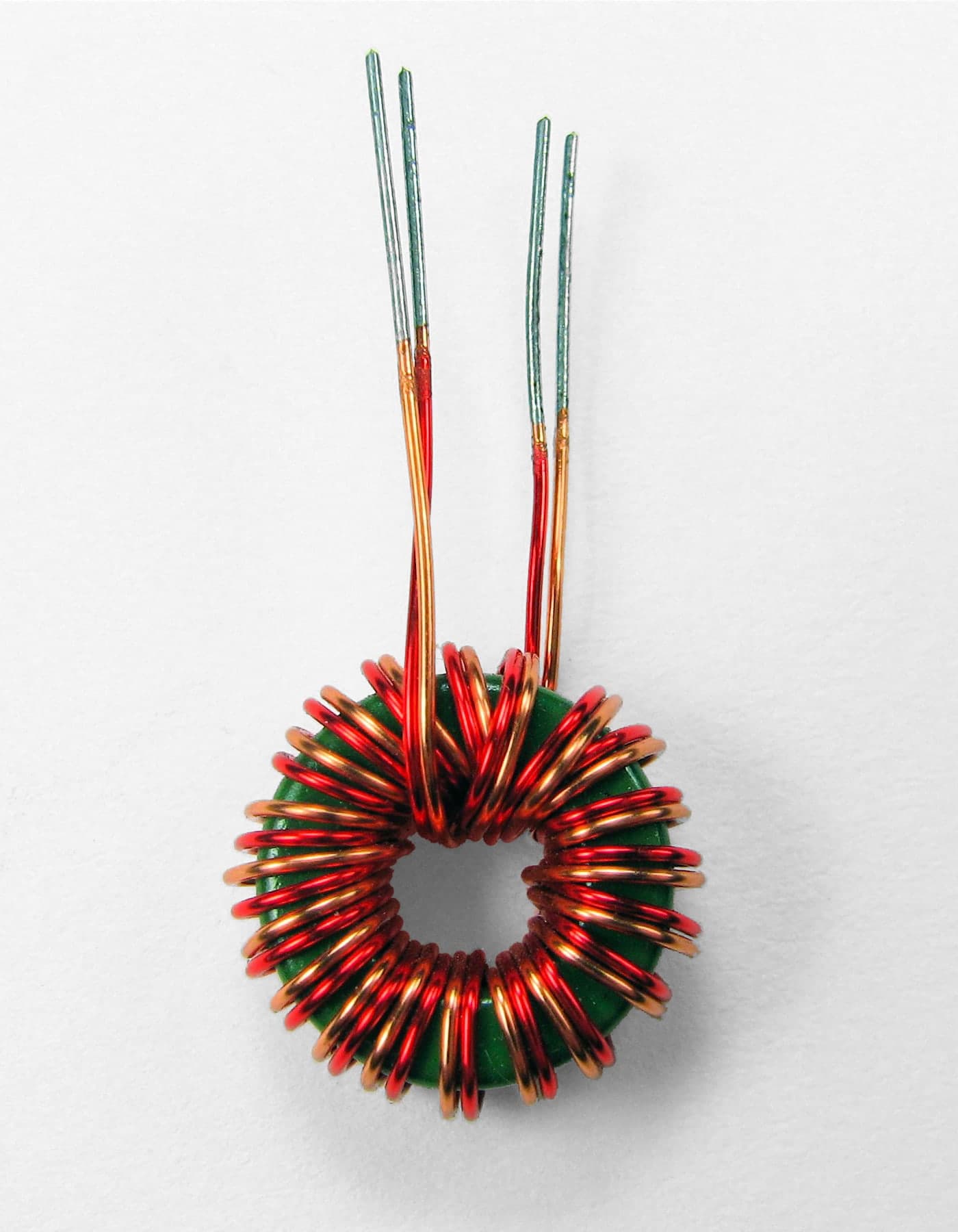
The basic structure is two coils of wire wound around a shared core, usually made of iron. When an alternating current flows through one coil — the primary — it creates a magnetic field that varies in strength and direction as the current oscillates. That varying field passes through the iron core, and the core channels it through the second coil — the secondary. The changing magnetic flux through the secondary coil induces a voltage across it, and if that coil is part of a closed circuit, a current will flow. Energy has moved from the primary circuit to the secondary circuit, but the two remain electrically separate. No wire connects them.
The ratio of turns in the two coils determines the voltage relationship. If the secondary coil has more turns than the primary, the induced voltage will be higher than the input voltage: a step-up transformer. If it has fewer turns, the voltage drops: a step-down transformer. This is the mechanism that allows electrical power systems to operate at different voltages for different purposes.
Transmission over long distances is more efficient at high voltage, because for a given amount of power, higher voltage means lower current, and resistive losses in the wire scale with the square of the current. A step-up transformer at the generating station raises the voltage for transmission. At the other end, near where the power will be used, a step-down transformer reduces it to a safer, more practical level for homes and businesses. The grid depends on this ability to change voltage without changing the nature of the power itself.
The transformer is a passive component. It has no moving parts, no switches, no source of energy of its own. It simply couples two circuits through a magnetic field, and the physics of induction does the rest.
Why it mattered then
Faraday's discovery of electromagnetic induction in 1831 opened the theoretical possibility of transferring electrical energy between circuits without a direct connection, but that possibility remained largely theoretical until alternating current systems began to develop later in the century. The reference material records the invention of the constant-potential transformer in 1885, and that device became essential to the transmission, distribution and use of alternating current electrical power. Before transformers, electrical systems were limited by the voltage at which they operated. Direct current systems, which were common in the early years of electrification, could not easily change voltage levels, and that meant power had to be generated at the voltage it would be used. Transmission over any distance was inefficient, because the current required for useful power at low voltage produced significant resistive heating in the wires. Generating stations had to be close to the loads they served. The transformer changed that constraint. With alternating current and transformers, a generating station could produce power at one voltage, step it up for efficient transmission over long distances, and step it down again near the point of use. That made centralised generation practical, and it made the electrical grid possible as a system.
Why it matters now
The electrical grid as it exists today rests on the transformer. Power generated at a station is stepped up to transmission voltages — often hundreds of kilovolts — for long-distance travel along high-voltage lines. Substations step the voltage down in stages: to distribution levels, then to the voltage that enters a building. Every time power crosses from one voltage level to another, a transformer is doing the work. The same principle operates at smaller scales. The power supply inside a laptop or a phone charger contains a transformer, stepping mains voltage down to the few volts the device needs. Audio equipment uses transformers to couple signal stages while keeping them electrically isolated. Radio-frequency circuits use tiny transformers to match impedances between components. The transformer's ability to provide galvanic isolation — to transfer energy while keeping two circuits electrically separate — matters for safety and for circuit design. It allows sensitive electronics to be powered from mains voltage without a direct conductive path, reducing the risk of fault currents and electrical shock. It allows different parts of a system to operate at different voltage levels and with different ground references, which simplifies design and improves reliability. Faraday's 1831 discovery of induction was about understanding how magnetic fields and electric currents interact. The transformer is the device that made that understanding into infrastructure.
The surprising detail
The discovery date recorded is 1831, the year Faraday discovered electromagnetic induction, not the year anyone built a practical transformer. The device came later — the reference material mentions 1885 for the constant-potential transformer — but the principle it relies on was understood decades earlier. The gap between discovering a physical law and engineering a device that exploits it is often longer than the popular story suggests.
Remember this
A transformer moves electrical energy between circuits through a changing magnetic field, with no conductive connection between them.
Test yourself
Why does the electrical grid use transformers to step voltage up for transmission and down for use, rather than generating and transmitting power at the voltage it will be used?
For a given amount of power, higher voltage means lower current, and resistive losses in transmission wires scale with the square of the current. Stepping the voltage up at the generating station reduces the current flowing through the transmission lines, which reduces the energy lost as heat. At the receiving end, transformers step the voltage back down to safer, more practical levels for homes and businesses. Without transformers, long-distance transmission would be far less efficient, and generating stations would need to be much closer to the loads they serve.
Go deeper
Image: Windell Oskay from Sunnyvale, CA, USA, CC BY 2.0. Licence: CC BY 2.0. Source.