I · THE OBJECT · BRITISH MUSEUM
The Oxbow
▶ Listen · narrated
A painting can record terrain, weather and a way of organising attention; this large canvas asks us to notice how those purposes meet.
At a glance
- Artist
- Thomas Cole
- Date
- 1836
- Medium
- Oil paint on canvas
- Size
- 130.8 × 193 cm (6 ft 4 in)
- Collection
- Metropolitan Museum of Art
Look closer
The river’s turn
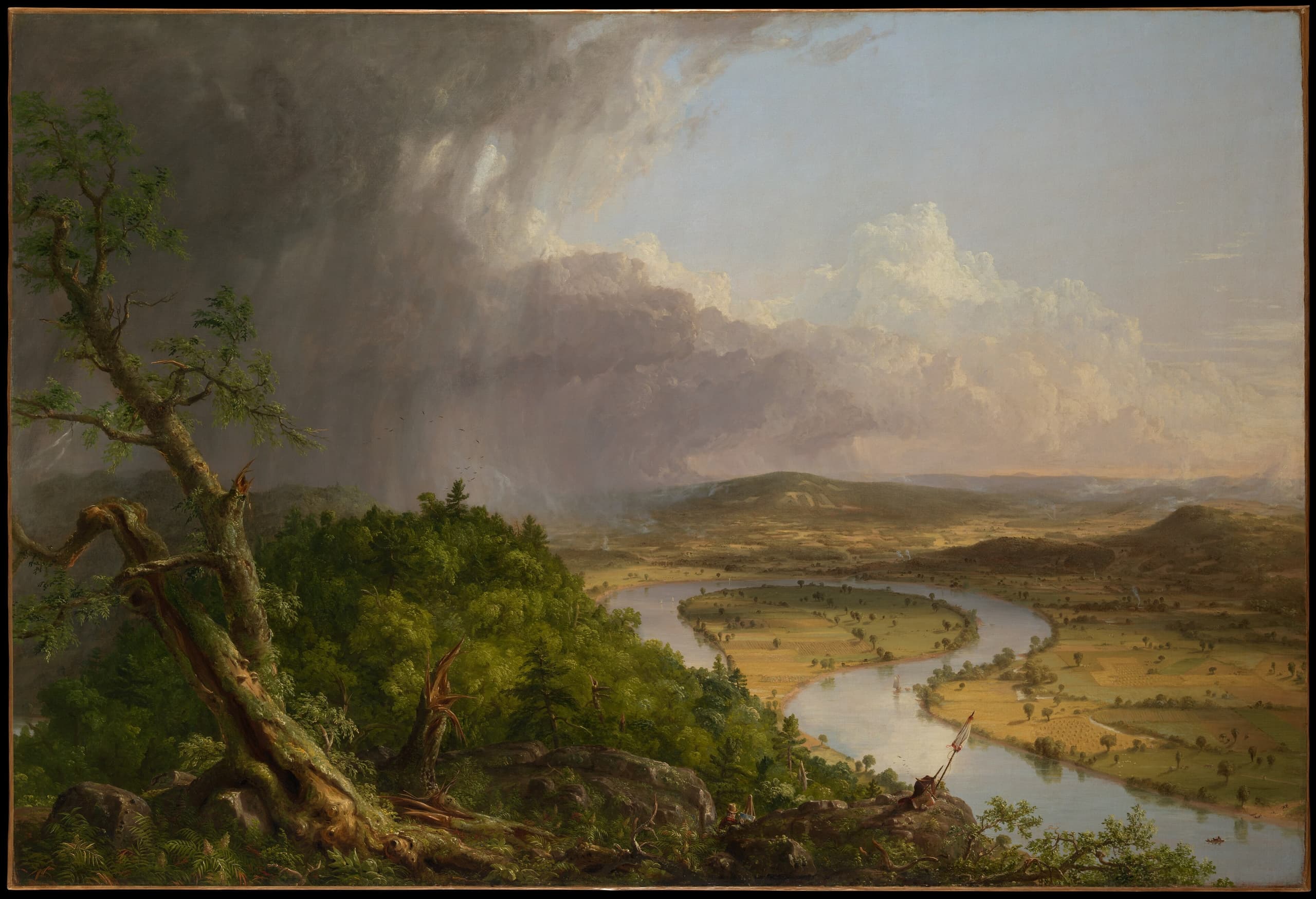
The broad curve of the river is the picture’s organising shape. Rather than moving directly away from the viewer, it loops through the landscape and carries the eye across the canvas. That bend gives a large, horizontal painting a clear route through its terrain.
Weather as structure
The scene is set after a thunderstorm, so weather is not merely an incident at the edge of the view. The changing sky divides the landscape into different conditions of light and visibility. The painting asks the viewer to read land and atmosphere together.
A panoramic viewpoint
This is a topographic landscape as well as a landscape painting: it presents a particular stretch of terrain in a wide view. Its nearly two-metre width gives room for distance, river and sky, making the act of surveying the place part of the image’s subject.
The story
The Oxbow is a painting by Thomas Cole, made in 1836 with oil paint on canvas. It belongs to the Metropolitan Museum of Art, where it is located under the inventory number 08.228. At 130.8 centimetres (4 ft 3 in) high and 193 centimetres (6 ft 4 in) wide, it is a notably broad canvas: a format suited to a landscape that unfolds laterally rather than concentrating attention on one close object.
The work is classified as both landscape painting and topographic landscape. Those terms matter together. A landscape painting can make weather, distance and the shape of land its central material. A topographic landscape also directs attention towards a particular place and its visible arrangement. Here, the curve of the river provides the image with a durable visual structure. It is not simply scenery; it is the line that gathers the rest of the view around it.
The reference description identifies the setting as the Connecticut River Valley after a thunderstorm. In such a scene, the sky and land cannot be separated neatly. Weather affects what can be seen, while the breadth of the terrain makes changes in light part of the composition. The view is panoramic, but it does not offer a neutral inventory. It presents a place through selection, scale and a carefully arranged viewpoint.
Cole is associated with the Hudson River school. That classification places this work within a movement concerned with American landscape, though the supplied facts do not establish a single meaning for this particular painting. It has been interpreted as a confrontation between wilderness and civilisation. That remains an interpretation, not a fact that can be extracted from the canvas without argument. What is plainly available to the eye is a structured contrast between a river valley, weather and the marks of a seen, ordered landscape.
The available record identifies the work’s maker, date, medium, dimensions and present collection. It does not say how the painting was found, acquired, or brought to the Metropolitan Museum of Art. That gap is worth keeping visible. A museum inventory can tell us much about an object’s present status without supplying its full earlier history.
Why it mattered then
Made in 1836, the painting belongs to the nineteenth century and to the Hudson River school. Its scale and topographic character gave landscape the seriousness of a major subject rather than treating it as a decorative backdrop. The work’s wide format allows a river valley and changing weather to become the subject of sustained attention. Its later interpretation as a confrontation between wilderness and civilisation suggests why the image could carry more than descriptive interest in its own moment. The supplied evidence does not settle that interpretation, but it does show that the painting brings an ordered view of terrain into contact with a recently stormy atmosphere.
Why it matters now
The Oxbow still matters because it makes looking feel consequential. A wide view can seem comprehensive, yet every view has been framed: a vantage point has been chosen, a river bend has been made central, and weather has been given a role in the picture’s meaning. The painting also offers a useful check on easy claims about landscape. Calling a scene “natural” can conceal the ways it is surveyed, composed and interpreted. Cole’s canvas does not require a single fixed reading. It rewards attention to the relation between terrain, atmosphere and the person who has arranged this expansive view for us.
The surprising detail
The painting is almost two metres wide, but its subject is not a single monument or event. Its scale is devoted to a view: the turn of a river, the spread of a valley and the weather after a storm. That choice makes the act of looking across a landscape the work’s central drama.
What is disputed
The supplied facts identify the work as a Hudson River school landscape and note an interpretation involving wilderness and civilisation. They do not establish that interpretation as the painting’s sole or intended meaning.
How it got here
The supplied record confirms that the painting is in the collection of, and located at, the Metropolitan Museum of Art. It provides no information about its earlier ownership, acquisition by the museum, or any contested-ownership context.
Remember this
The Oxbow uses a broad view, a river bend and storm-cleared weather to make landscape itself a subject of thought.
Test yourself
Why is it useful to describe this work as both a landscape painting and a topographic landscape, rather than choosing only one label?
The two labels draw attention to different aspects of the same image. “Landscape painting” tells us that land, weather and distance are its visual subject. “Topographic landscape” suggests that the view also concerns a particular terrain and its arrangement. Together, they prevent us from treating the painting as either pure scenery or a simple geographic record.