II · THE DISCOVERY · HISTORY OF SCIENCE
Phobos
Mars has two moons, both small and both discovered in the same week. The inner one, Phobos, moves so quickly that it rises in the west.
At a glance
- Discovered
- 17 or 18 August 1877
- Discoverer
- Asaph Hall, an American astronomer
- Type
- Moon of Mars
- Diameter
- 22.5 kilometres
- Named after
- Phobos, the Greek god of fear
Look closer
The date is recorded two ways
The discovery date for Phobos appears in records as both 17 August and 18 August 1877. This is not a disagreement about which night Hall saw it, but likely reflects when the observation happened in local time versus when it was recorded in another time zone, or a difference in how the discovery moment was defined. The two dates sit side by side in the record without one being preferred.
It orbits very close and very fast
Phobos circles Mars at a distance of 6,000 kilometres from the planet's surface. It completes an orbit in seven hours and thirty-nine minutes, which is faster than Mars rotates. From the Martian surface, Phobos would appear to rise in the west and set in the east, the reverse of what we see from Earth. For comparison, our Moon orbits at a distance of about 384,000 kilometres from Earth and takes about twenty-nine days to complete an orbit.
It is very dark
Phobos reflects very little of the sunlight that hits it. Its albedo — the fraction of light it reflects — is 0.071. For context, our Moon has an albedo of about 0.12, and even that is considered dark; fresh snow has an albedo near 0.9. Surface temperatures on Phobos range from about minus four degrees Celsius on the sunlit side to minus one hundred and twelve degrees on the shadowed side.
The story
Asaph Hall discovered Phobos on either 17 or 18 August 1877 — the record gives both dates, likely reflecting how the observation was logged. Hall was an American astronomer searching for moons around Mars during a period when the planet was particularly close to Earth. Within days he found both of Mars's moons: Deimos, the outer one, and Phobos, the inner.
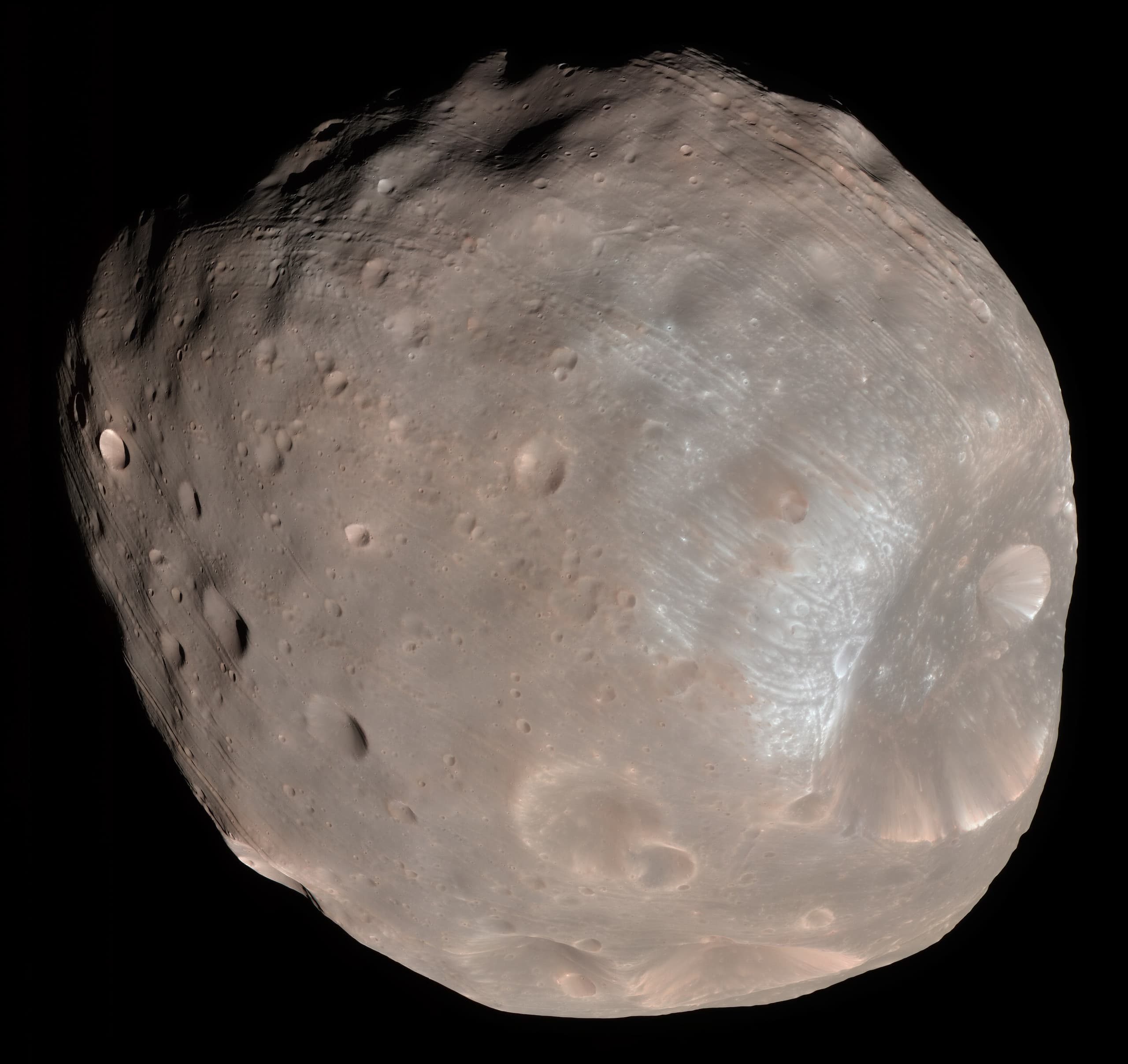
Phobos is small. Its diameter is 22.5 kilometres, and it is not a sphere but an irregularly shaped object with a mean radius of eleven kilometres. It orbits extremely close to Mars, just 6,000 kilometres above the surface. The closeness produces a striking effect: Phobos completes an orbit in seven hours and thirty-nine minutes, which is faster than Mars rotates on its axis. Seen from the Martian surface, Phobos would rise in the west, cross the sky in four hours and fifteen minutes or less, and set in the east. It would do this twice in a single Martian day.
The moon is named after Phobos, the Greek god of fear and panic. In mythology, Phobos is the twin brother of Deimos — the name given to the outer moon — and both are sons of Ares, the Greek counterpart to Mars.
Phobos reflects very little light. Its albedo, the measure of how much sunlight a surface reflects, is 0.071. The surface is dark, and temperatures range from about minus four degrees Celsius on the side facing the Sun to minus one hundred and twelve degrees in shadow.
The most prominent feature on Phobos is a large impact crater called Stickney, which takes up a substantial portion of the moon's surface. The surface is also marked by grooves, and there are several theories about how these formed. One explanation involves tidal forces from Mars — the gravitational pull that stretches and compresses the moon as it orbits.
Images and models suggest that Phobos may be a rubble pile, a collection of fragments held together by a thin crust, and that this structure is being torn apart by tidal interactions with Mars. Phobos is moving closer to the planet by about two centimetres per year.
Why it mattered then
Before Hall's discovery, Mars was thought to have no moons. The question had been open for a long time — observers had looked, but the moons are small and faint, and Mars is far away. Finding them required both a good telescope and Mars being close enough to Earth for the observation to succeed. The 1877 discovery settled the question and gave Mars two companions, both irregular and both orbiting close to the planet. Within the same decade, the two moons were named, and their orbits were measured. The discovery of Phobos and Deimos completed the survey of moons in the inner solar system: Mercury and Venus have none, Earth has one, and Mars has two.
Why it matters now
Phobos remains of interest because its orbit is decaying. Moving closer to Mars by about two centimetres per year means that, over a long enough span, it will either break apart under tidal stress or collide with the planet. The timescale for this is not immediate — estimates place it in the tens of millions of years — but it makes Phobos a body whose future is constrained. Images and models suggest it may already be a rubble pile held together by a thin crust, which would mean the process of breaking apart is underway. Whether Phobos is a captured asteroid or a piece of Mars itself, knocked into orbit by an ancient impact, remains uncertain, and the grooves on its surface are still debated. It is one of the closest objects to another planet in the solar system, and that closeness continues to shape it.
The surprising detail
From the surface of Mars, Phobos would rise in the west and set in the east, the opposite of what we see from Earth. This happens because Phobos orbits Mars faster than Mars rotates. It completes an orbit in seven hours and thirty-nine minutes, while a Martian day lasts about twenty-four and a half hours. The result is that Phobos overtakes the rotation of the planet, crossing the sky in just over four hours and doing so twice in a single Martian day. It would appear to move the wrong way across the sky, a consequence of its unusually close and fast orbit.
What is disputed
The discovery date is recorded as both 17 August and 18 August 1877. This likely reflects a difference in how the observation was logged — whether in local time or another time zone, or a difference in defining the moment of discovery — rather than uncertainty about which night Hall made the observation. Both dates appear in the record without one being preferred over the other.
Remember this
Phobos orbits Mars faster than Mars rotates, so it rises in the west.
Test yourself
Why does Phobos rise in the west when seen from Mars, rather than in the east like our Moon does from Earth?
Phobos orbits Mars in seven hours and thirty-nine minutes, which is faster than Mars rotates on its axis — a Martian day lasts about twenty-four and a half hours. Because the moon is moving around the planet faster than the planet is turning, Phobos overtakes the rotation. From the surface, this makes it appear to rise in the west and set in the east, the opposite of what we see from Earth. Our Moon takes about twenty-nine days to orbit Earth, much slower than Earth's rotation, so it rises in the east. The direction a moon appears to move depends on whether it orbits faster or slower than its planet spins.
Go deeper
Image: NASA / JPL-Caltech / University of Arizona, Public domain. Licence: Public domain. Source.