I · THE OBJECT · BRITISH MUSEUM
The Siesta
▶ Listen · narrated
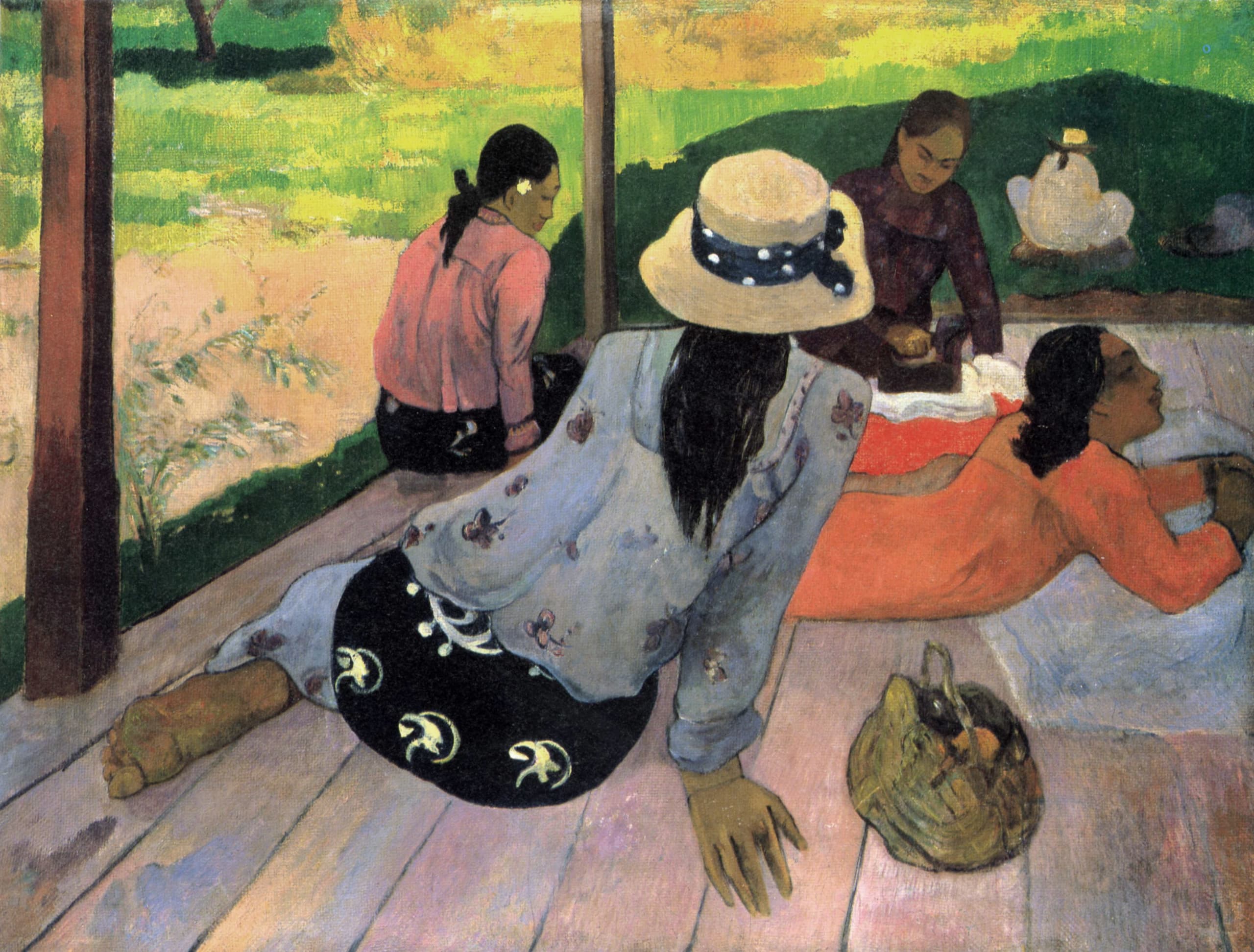
A quiet afternoon on a Tahitian verandah, painted in oil by Paul Gauguin around 1892. Ordinary clothes, ordinary tasks — and a canvas revised until a dog gave way to a bag.
At a glance
- Date
- 1892
- Artist
- Paul Gauguin
- Material
- Oil paint on canvas
- Dimensions
- 88.9 × 116.2 cm (3 ft 10 in)
- Genre
- Genre art
- Inventory
- 1993.400.3
Look closer
Western dress, not costume
The women wear westernised clothes rather than the exotic dress a European audience might have expected from a Tahitian scene. Blouses, skirts and modest covers sit under the verandah shade. The choice keeps the picture close to observed daily life and away from the staged tropical fantasy that often accompanied Pacific subjects in European painting of the period.
One woman ironing
Among the group at rest, one figure is occupied with ironing. The task anchors the scene in ordinary domestic labour. Heat, shade and the pause of the afternoon are not abstract moods here; they are the conditions under which someone still works while others talk.
A bag that was once a dog
In the foreground sits a shopping bag. Technical examination and the record of changes show that this passage was previously a dog. Gauguin altered the canvas over a long period; the substitution is one clear trace of that revision. The final still-life object steadies the composition without the narrative pull a living animal would have brought.
The story
The Siesta is an oil painting on canvas by Paul Gauguin, dated 1892 and now in the Metropolitan Museum of Art in New York. Its inventory number is 1993.400.3. The work measures 88.9 by 116.2 centimetres (3 ft 10 in) and belongs to the genre of everyday life painting rather than history, portrait or pure landscape.
It was made during Gauguin’s first extended stay on the island of Tahiti. The picture shows a group of Tahitian women gathered in the cool shade of a verandah while the afternoon sun remains outside the frame. They wear westernised clothes. One of them irons. Others sit and talk. Nothing in the subject announces ceremony, myth or colonial spectacle; the scene is an unpretentious record of rest and small domestic work in the heat of the day.
Despite that modest subject, the canvas was not dashed off. Gauguin worked on it over a long period and made several changes. One of the clearest is in the foreground, where a shopping bag now occupies a place that once held a dog. The shift matters because it shows him adjusting the balance of the picture: a living animal would have drawn the eye and suggested narrative; a bag sits quietly as still life and leaves the women as the centre of attention.
The painting therefore sits at an interesting junction. It is a Tahitian subject by an artist already associated with the search for a non-European visual language, yet its clothes, tools and verandah speak of a contact culture already shaped by mission, trade and administration. What we see is neither an untouched island nor a studio fantasy, but a shaded interior in which local women pass the hottest hours in mixed dress, with ironing still to be done.
Why it mattered then
In the early 1890s Gauguin was working far from the Paris salons, yet still for a European market that expected something vivid from the Pacific. A painting of Tahitian women at rest in westernised clothes answered that expectation only partly. It offered the place-name and the bodies that collectors associated with his Tahitian period, while refusing the more theatrical props of exoticism. The long revision of the canvas — including the replacement of a dog by a shopping bag — suggests he was not content with a quick ethnographic sketch. He treated an ordinary afternoon as a composition worth adjusting until the relationships of colour, shade and attention felt resolved. In its own moment the picture was a claim that daily life on a verandah could carry as much pictorial weight as myth or nude.
Why it matters now
The Siesta still matters because it complicates the easy story of Gauguin in Tahiti. Viewers who come for saturated colour and an idea of escape meet instead a group of women in contemporary dress, one of them ironing, all of them sheltered from the sun. The painting keeps open the question of what a European artist could see, and what he chose to change, when he painted colonised space as genre rather than as paradise. The documented alteration from dog to bag is a small reminder that even an “everyday” scene is constructed. Looking closely remains a way to watch that construction at work, without needing to inflate the picture into a masterpiece or dismiss it as mere tourism.
The surprising detail
The shopping bag in the foreground was not always a bag. Gauguin had painted a dog there first and later replaced it. The change is one of several revisions made while he kept the canvas in hand over a long stretch of time. A minor still-life decision quietly redirected the whole mood of the lower edge of the picture.
What is disputed
Wikidata records the inception date as 1892; other catalogue traditions extend the working period into 1894, which fits the evidence that Gauguin kept adjusting the canvas over a long stretch. The precise sequence of all changes beyond the dog-to-bag alteration is not fully settled in the sources used here.
Remember this
An ordinary Tahitian afternoon, western dress and ironing included — reworked until a dog in the foreground became a shopping bag.
Test yourself
Why does the change from a dog to a shopping bag in the foreground alter more than a single detail of The Siesta?
A dog would have introduced movement, companionship and a small narrative pull at the lower edge of the canvas. A shopping bag behaves as still life: it holds the corner of the composition without competing with the women for attention. The substitution shows Gauguin treating an everyday verandah scene as a carefully balanced picture, not a snapshot, and it leaves the social centre of the work — rest, talk and ironing in the shade — undisturbed by an animal presence.
Go deeper
Image: Paul Gauguin, Public domain. Licence: Public domain. Source.