I · THE OBJECT · BRITISH MUSEUM
A Faun Teased by Children
▶ Listen · narrated
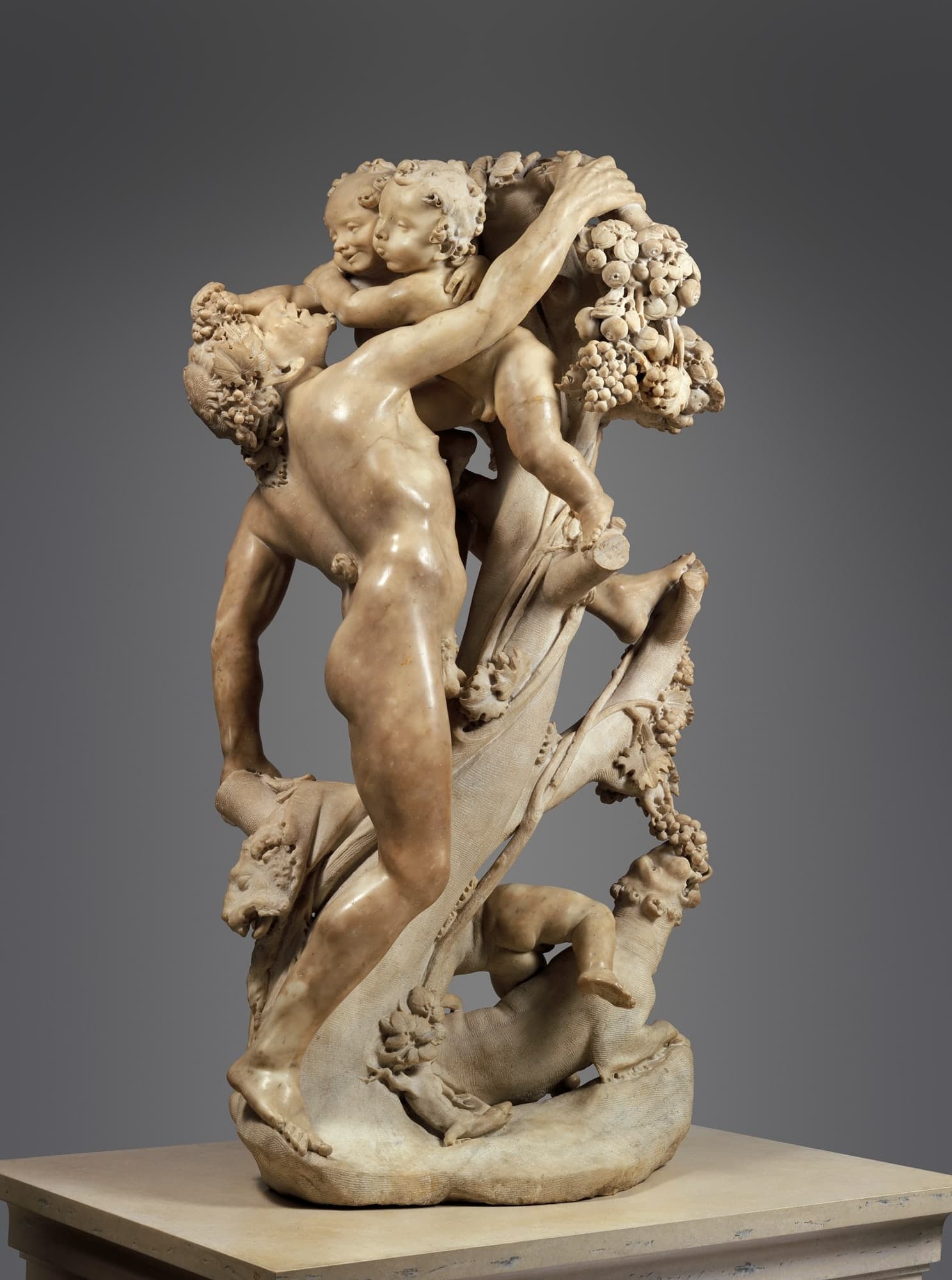
A faun teased by children sounds like a small subject. In 1616 it was cut in marble by Pietro Bernini and his son Gian Lorenzo, and it still stands in the Metropolitan Museum of Art.
At a glance
- Date
- 1616
- Material
- Marble
- Height
- 132.4 cm (4 ft 4 in)
- Creators
- Gian Lorenzo Bernini; Pietro Bernini
- Movement
- Baroque
- Inventory
- 1976.92
Look closer
Two makers, one group
The work is credited to both Gian Lorenzo Bernini and his father Pietro. That double attribution is itself something to hold in view. The marble is a single group of sculptures, not a pair of separate figures later joined; whatever each man cut, the result was meant to read as one action — a faun and the children who tease him — rather than as a demonstration of two styles side by side.
Scale you can measure
At 132.4 centimetres (4 ft 4 in) high the group is neither a tabletop toy nor a monumental fountain figure. It sits at roughly human torso height, close enough that the tangle of limbs and the small bodies of the children remain legible without a ladder, and large enough that the marble has weight and presence in a gallery. The material is marble throughout; nothing here is cast or pieced from mixed media.
A Baroque subject, plainly named
The title does not dress the scene as allegory. A faun is teased by children: the genre is a group of sculptures, the movement Baroque, the country of origin Italy. What you are asked to notice is the physical comedy of the encounter — adult satyr flesh set against smaller hands and bodies — rather than a hidden programme. The mythological type is familiar; the claim of the piece is in how that type is carved.
The story
A Faun Teased by Children is a marble sculpture made in Italy in 1616. It belongs to the Metropolitan Museum of Art, where it is held under the inventory number 1976.92. Its creators are recorded as Gian Lorenzo Bernini and Pietro Bernini — son and father — and it is classed as a group of sculptures within the Baroque movement.
The subject is exactly what the title states. A faun, the woodland follower of Bacchus familiar from classical and Renaissance art, is set upon by children. Nothing in the secured facts elaborates a lost inscription or a named patron; the work is identified by that encounter and by the hands that cut it. At 132.4 centimetres (4 ft 4 in) high it is a substantial gallery object, large enough for the tangle of figures to read as a true group rather than a relief or a single statue with attributes.
Dual authorship is the fact that organises almost everything else we can say with certainty. Pietro Bernini was an established sculptor; Gian Lorenzo is named beside him on the same work. The marble does not, on the evidence given here, divide itself into signed zones. Viewers and cataloguers inherit a single group and two names. That is a different kind of object from a solo early masterpiece or a workshop product issued only under the master’s name. It is a collaboration entered in the record as such.
The date places the group in the early seventeenth century, in the orbit of the Baroque as a movement rather than as a loose adjective. Italy is the country of origin; the Metropolitan Museum of Art is both collection and present location. Beyond those anchors the public story thins. How the marble left Italy, through whose hands it passed, and on what terms it entered the museum in the year suggested by its accession number are not supplied in the verified facts, and so they are not narrated here.
What remains is clear enough to carry a lesson. A mythological group in marble; a measured height; a father and a son both credited; a museum number that fixes it in New York. The rest — who blocked out the faun, who finished a child’s hand, whether the work extended past 1616 — belongs either to specialist literature or to silence. The object does not need more invention to matter. It needs accurate naming: material, makers, date, place, and the simple drama of a faun teased by children.
Why it mattered then
In 1616 a marble group of this kind sat inside a live economy of workshops, patrons, and classical subjects. Naming both Pietro and Gian Lorenzo Bernini on one sculpture mattered because training and reputation often travelled along family lines; a son’s hand could be formed, and publicly announced, on stone that still carried the father’s name. The Baroque label, applied to the movement rather than to a single flourish, points to a period taste for animated groups and mythological play — a faun and children rather than a solitary ideal nude. The work did not have to invent its subject; it had to carve a familiar type with enough physical wit to hold a room. Collaboration on a single group also answered a practical demand: complex multi-figure marble took time, skill, and more than one chisel if it was to be finished for a client. Dual credit, where it was given, fixed that labour in the record instead of absorbing it into one signature.
Why it matters now
The group still matters because it refuses a simple genius narrative without denying Gian Lorenzo Bernini’s presence. Two makers share the catalogue entry; the marble is one object. That tension is useful in a museum culture still tempted to isolate the youthful prodigy from the workshop that trained him. Standing in the Metropolitan Museum of Art, inventory 1976.92, the sculpture also anchors Baroque Italy in a concrete height, material, and subject rather than in a haze of later fountains and chapels. Visitors who know only the famous name meet the father beside the son, and meet a faun under the hands of children instead of an ecstatic saint. The piece keeps early collaboration visible. It reminds us that movement labels such as Baroque describe shared habits of making as much as solitary breakthroughs, and that a mythological tease cut in marble can carry that lesson as well as any treatise.
The surprising detail
The catalogue does not separate the hands. Gian Lorenzo Bernini and Pietro Bernini are both named as creators of one marble group, yet the verified record does not assign the faun to one and the children to the other, or the rough work to the father and the finish to the son. The surprise is administrative as much as artistic: a single inventory number, 1976.92, holds a collaboration that the stone itself does not label by zone. Viewers are left with the whole tangle — and with two names — rather than a diagram of who cut what.
What is disputed
Wikidata gives the inception as 1616; some background accounts extend the execution into 1617. The verified facts do not settle how the work was divided between Pietro and Gian Lorenzo, nor do they record the find-spot, early provenance, or the path by which the marble entered the Metropolitan Museum of Art beyond its present collection status and inventory number 1976.92.
Remember this
A 1616 marble group of a faun and children, made in Italy by Pietro Bernini and Gian Lorenzo Bernini, now Metropolitan Museum inventory 1976.92.
Test yourself
The sculpture is credited to both Pietro Bernini and Gian Lorenzo Bernini, yet it is one marble group under a single inventory number. What does that combination force a careful viewer to hold at once?
That finished unity and shared labour are not opposites in the record. The object reads as one action — a faun teased by children — while the authorship remains double. Without a documented division of hands, you cannot honestly reduce the work to a solo early Bernini or to a father’s piece touched up by a son. The lesson is to keep both facts in view: one group, two makers, and no forced choice between them.
Go deeper
Image: Gian Lorenzo Bernini / Pietro Bernini, CC0. Licence: CC0. Source.