III · THE WORK · ART HISTORY
Road with Cypress and Star
▶ Listen · narrated
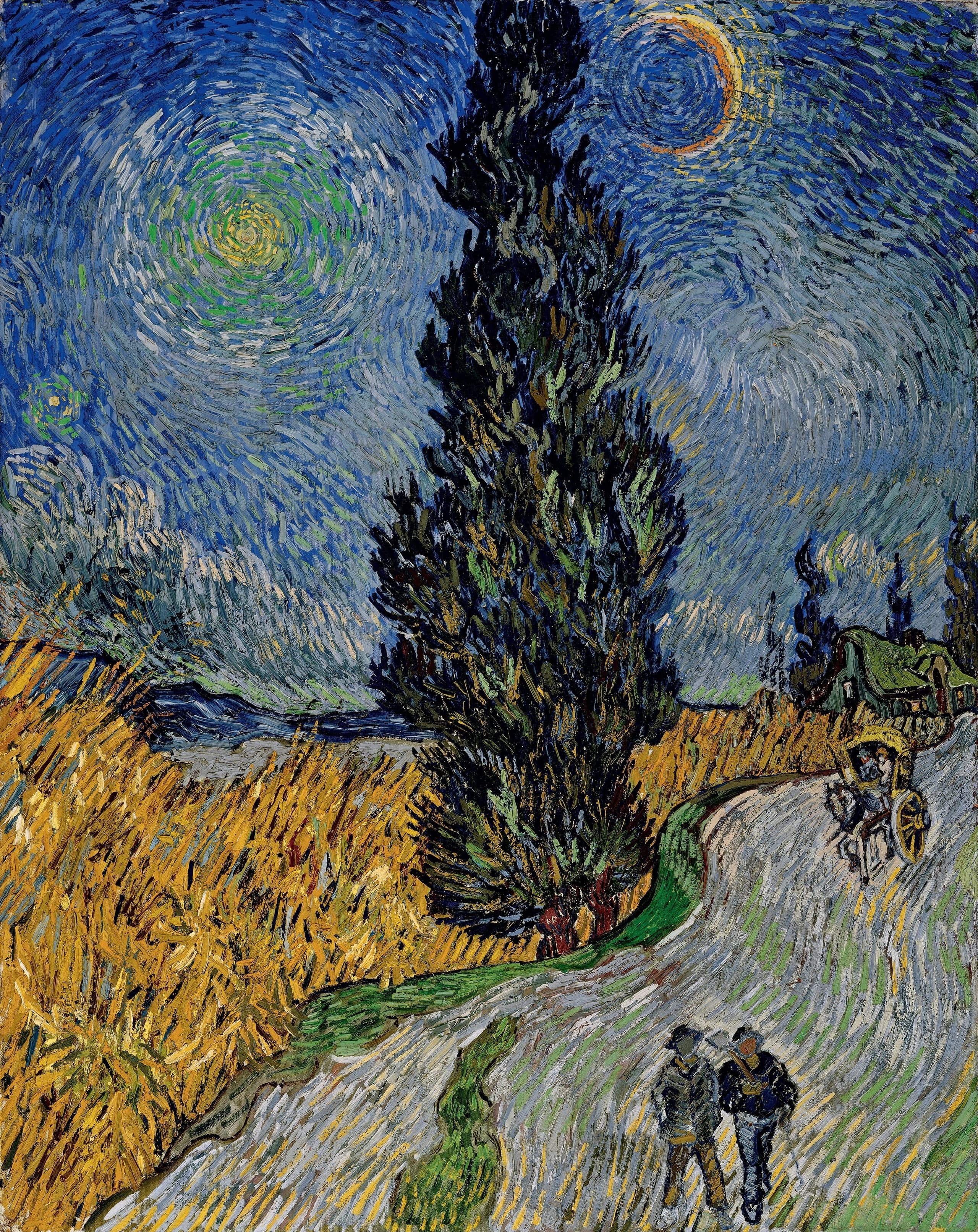
Van Gogh painted a road, a cypress and a star on a tall canvas in May 1890. It was his last work from Saint-Rémy-de-Provence, and it still rewards close looking.
At a glance
- Artist
- Vincent van Gogh
- Date
- 15 May 1890
- Medium
- Oil on canvas
- Dimensions
- 92 × 73 cm (2 ft 5 in)
- Collection
- Kröller-Müller Museum
- Genre
- Post-impressionism
Look closer
The tall dark tree
The cypress is the painting’s main upright. It climbs almost the full height of the canvas, a dense, flame-like mass of dark greens that joins the road below to the night above. On a support only seventy-three centimetres wide, that single vertical claims an unusual share of the surface and forces every other form to work around it.
Sky held by a star
The upper part of the canvas is given over to night. A bright star sits in the swirling blue field, large enough to read at a glance and placed so that it balances the dark rise of the tree. The sky is not a flat backdrop; its strokes turn and eddy, so the star feels fixed inside motion rather than stuck on top of it.
The road that opens
Below, a pale road cuts into the landscape and draws the eye inward. It is the painting’s main path through space: a lighter band against the darker ground, bending just enough to suggest depth without leaving the cypress behind. The road keeps the scene from becoming a pure tree study; it insists that this is a place one might walk.
The story
Road with Cypress and Star is an oil painting on canvas by Vincent van Gogh, begun and finished around 15 May 1890. It stands ninety-two centimetres high and seventy-three centimetres wide. That upright proportion is not incidental. A vertical support gives a tall tree room to rise, and Van Gogh uses nearly the full height for a single cypress that links earth to sky.
The essential motifs are few and plainly named in the title: a road, a cypress, a star. Around them the night landscape of Provence is built in directional strokes of oil paint. The tree is the strongest dark. The road is the strongest light path on the ground. The star anchors the upper air. Nothing else in the composition is allowed to rival those three claims.
The work belongs to the genre later called Post-impressionism, and it was the last painting Van Gogh made in Saint-Rémy-de-Provence. It is also known as Country Road in Provence by Night; its Dutch title, Cypres bij sterrennacht, puts the cypress and the starry night first. Today it is held by the Kröller-Müller Museum in the Netherlands under the inventory number KM 108.488, part of that museum’s large Van Gogh collection at Otterlo.
Compositionally the picture depends on crossed directions. The cypress is emphatically vertical. The road pulls inward and along. The sky moves in curves and turns. Colour is laid in separate, visible touches rather than smoothed into even tone, so the surface keeps a restlessness that matches the night subject. The star is not a tiny point; it is large enough, and warm enough, to answer the mass of the tree.
What the painting “means” is not settled by the surviving facts. One can say only what is on the canvas and where it sits in Van Gogh’s late chronology. He chose a tall format, a night road, a single dominating tree, and a star bright enough to hold the upper register. The result is a landscape organised around passage and ascent: a way forward on the ground, a way upward through the tree, and a fixed light in the moving sky.
Country of origin is recorded as the Netherlands, reflecting the painter’s nationality even though the motif is Provençal. The canvas itself did not remain in France. It entered the Kröller-Müller holdings and has stayed there, available for the kind of unhurried looking its structure invites: first the cypress, then the star, then the road that keeps the whole scene open.
Why it mattered then
In May 1890 Van Gogh was at the end of his stay in Saint-Rémy-de-Provence. This canvas is recorded as the last he made there. A night landscape built from a road, a cypress and a star fitted the motifs he had been testing in that period, and the vertical format let him push the tree through almost the full height of the support. Working in oil on canvas in a Post-Impressionist manner, he set strong directional contrasts — upright tree, inward road, turning sky — on a modest surface only seventy-three centimetres wide. The painting therefore marks a close rather than a beginning: a final Provençal night scene before he left that place, carried out with the compressed means he had refined on the spot.
Why it matters now
The painting still matters because its design is legible without special pleading. A viewer can stand before the ninety-two-centimetre height and watch the eye climb the cypress, catch on the star, and return along the road. That circuit is built into the surface, not added by later commentary. It also matters as a document of where Van Gogh’s Saint-Rémy work ended, now kept in the Kröller-Müller Museum rather than dispersed. Close looking remains the point: the inventory number, the dimensions and the plain inventory of motifs are enough to keep attention on what the paint actually does.
The surprising detail
For a landscape, the canvas is distinctly taller than it is wide — ninety-two centimetres high against seventy-three wide. That proportion is usually reserved for figures or interiors; here it is given to a road at night so that one cypress can run nearly from bottom edge to top. The last painting from Saint-Rémy is, in that sense, shaped by a tree.
What is disputed
The painting’s exact intended meaning is not fixed by the available record. Alternate titles stress either the road or the cypress and starry night; none supplies a single authorised reading of the scene.
Remember this
A tall canvas, a darker cypress, a lighter road, and a star: Van Gogh’s last Saint-Rémy painting is built from those four decisions alone.
Test yourself
The support is ninety-two centimetres high and only seventy-three wide. How does that vertical proportion change the role of the cypress compared with a wider landscape format?
On a wide canvas a cypress would be one vertical among many horizontal pulls. On this tall, narrow support the tree can occupy almost the full height, so it becomes the main structural member of the picture — the form that joins road to star — rather than a detail set inside a broad view. The proportion itself makes the cypress the painting’s spine.
Go deeper
Image: Vincent van Gogh, Public domain. Licence: Public domain. Source.