III · THE WORK · ART HISTORY
Marine Corps War Memorial
▶ Listen · narrated
Felix de Weldon sculpted the group; Horace W. Peaslee shaped the setting. Together they turned one image from Iwo Jima into a memorial for all Marines.
At a glance
- Creators
- Felix de Weldon; Horace W. Peaslee
- Dedicated
- 10 November 1954
- Materials
- Bronze, concrete, granite, cloth
- Height
- 78 feet
- Location
- Arlington Ridge Park
- Type
- War memorial; sculpture
Look closer
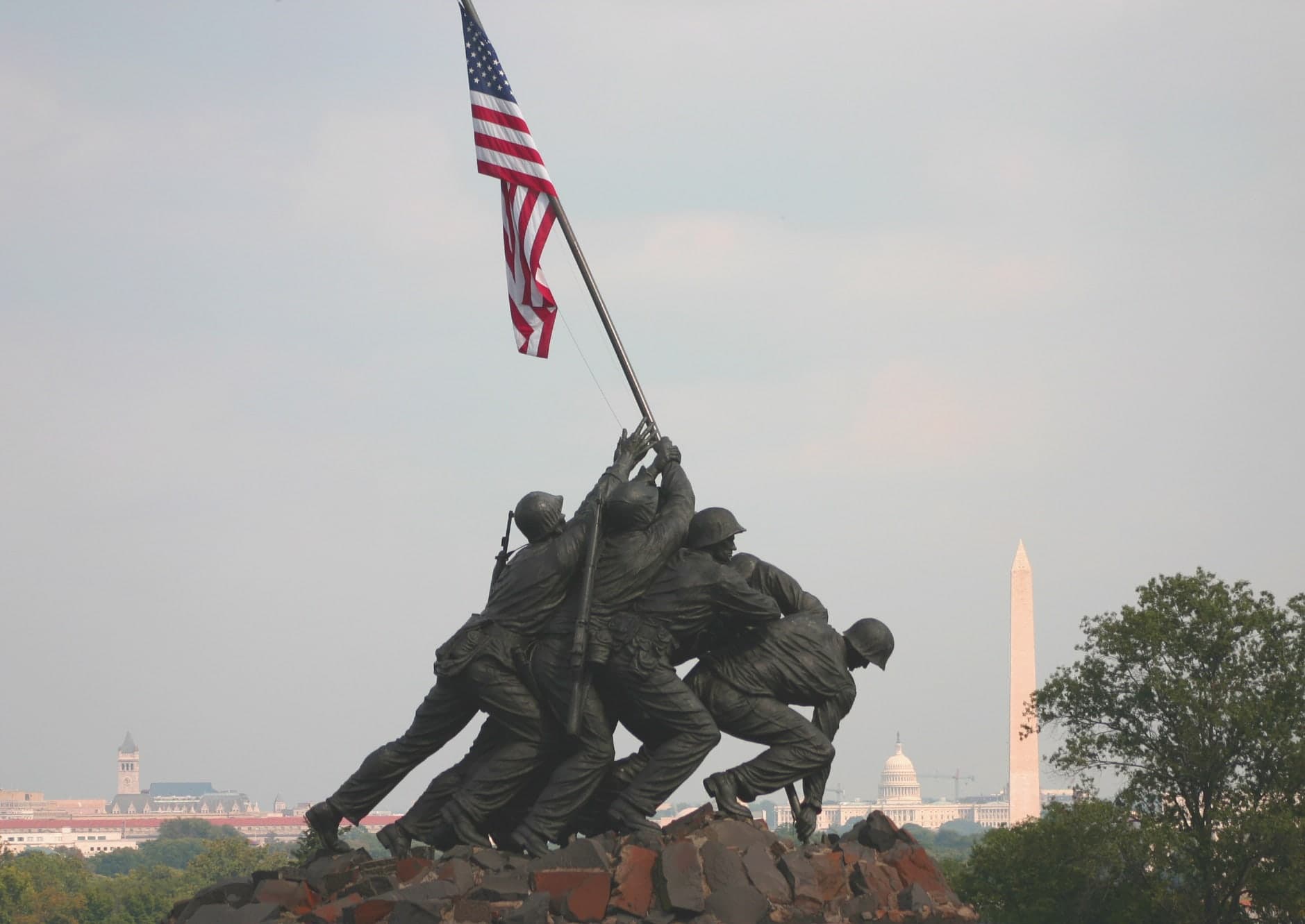
Six bodies, one effort
The composition is a single upward diagonal. Six figures lock around the base of a pole, legs braced, arms crossed and overlapping, so that no one man claims the gesture alone. The mass reads as a chain of force rather than a line of heroes. Hands meet metal; boots bite the ground. The photograph that inspired the work had already fused the men into one action; the bronze keeps that fusion and hardens it.
Cloth among the metals
The listed materials are not all hard. Bronze forms the figures and the pole; concrete and granite carry the base; cloth is named for the flag itself. A fabric surface moves in weather where the bodies cannot. That choice keeps a living element inside a memorial otherwise cast for permanence, and it ties the sculpture back to the temporary, wind-caught flag in the source image.
Height as argument
Seventy-eight feet is not a neutral measurement. It lifts the group above ordinary eye level so that the viewer meets the action from below, as if still climbing. The scale turns a momentary hoist into a public landmark visible across Arlington Ridge Park, and it fixes the memory of one ridge on a distant island into the skyline of the capital’s edge.
The story
The Marine Corps War Memorial stands in Arlington Ridge Park, close enough to Arlington National Cemetery that the two sites are often named together. It is a sculpture and a war memorial at once: six figures cast in bronze, a pole, a cloth flag, a base of concrete and granite, rising to a height of seventy-eight feet. Its inception date is 10 November 1954.
The work was designed by the sculptor Felix de Weldon with the architect Horace W. Peaslee. Its composition follows a single famous photograph taken in 1945 by the Associated Press combat photographer Joe Rosenthal: six Marines raising a United States flag atop Mount Suribachi during the Battle of Iwo Jima. De Weldon, then serving in the Navy at Patuxent River Naval Air Station in Maryland, saw the image and modelled a small version of the group in a single weekend. That early maquette became the seed of the full memorial.
The path from sketch to dedication was not immediate. A proposal went before Congress while the war still ran, but funding was not available then. In 1947 a federal foundation was formed to raise the money. By the time the memorial was dedicated on 10 November 1954, the subject had widened. The group still freezes the Suribachi moment, yet the memorial was dedicated to all Marines who had given their lives in defence of the United States since 1775. One battle supplies the image; a longer service history supplies the claim.
What you meet on the ground is a study in shared strain. The figures do not stand in a neat rank. They crowd the pole, bodies angled and overlapping, so that the eye travels up a thicket of limbs rather than along a parade line. Boots plant; knees bend; shoulders take weight. The largest forms are the men and the pole; the flag, in cloth, is the one part allowed to answer the wind. Bronze holds the bodies still. Fabric keeps a trace of weather and chance.
Peaslee’s contribution is the setting as much as any single detail of the group. The memorial sits in open park ground where the silhouette can be read at a distance, and where the upward thrust of the pole meets sky rather than a crowded street wall. In 1955 the memorial was turned over to the National Park Service. It remains a public object in a designed landscape: approached on foot, seen against trees and open air, near the Ord-Weitzel Gate and the Netherlands Carillon along the George Washington Memorial Parkway.
Close looking rewards patience with the lower half as much as the flag. The bronze surfaces carry the marks of hands, rope and metal fittings; the base in concrete and granite steadies a mass that would otherwise seem to pitch forward with the effort it depicts. Nothing in the group is casual. Every angle is borrowed from a photograph already fixed in public memory, then enlarged until that memory occupies real space and real height.
Why it mattered then
In 1954 the United States was still absorbing the cost of the Second World War and living with newer conflicts. A memorial that began from one of the war’s most widely circulated photographs offered a ready symbol, already known to millions, for sacrifice that stretched beyond a single island. Dedicating the work to Marines lost since 1775 folded the Suribachi image into a longer institutional story. The choice of Arlington Ridge Park placed that story at the edge of the national cemetery landscape, where private grief and public form already met. De Weldon and Peaslee’s collaboration answered a demand for a monument that could be recognised at once and still function as civic architecture rather than a simple statue on a plinth.
Why it matters now
The memorial continues to work because it is both specific and transferable. The composition still points to one photograph and one battle, yet the dedication language keeps the group from belonging only to 1945. Visitors who never saw the original image still read the upward force of six bodies on a pole. Those who know the photograph measure the bronze against it. Either way, the sculpture remains a place where looking, remembering and institutional identity overlap in open air. Its materials — bronze that holds, cloth that wears, granite that anchors — make the terms of that remembering physical rather than abstract.
The surprising detail
Among the stated materials is cloth. The figures, pole and structural mass are bronze, concrete and granite; the flag is fabric. A memorial built for permanence therefore keeps one surface that frays, fades and must be replaced. The choice quietly separates the men, fixed forever in the act of raising, from the flag, which goes on living in weather. It is a practical detail and a conceptual one at once.
What is disputed
Wikidata lists both Arlington National Cemetery and Arlington Ridge Park as locations. The memorial stands in Arlington Ridge Park, near the cemetery rather than inside its burial grounds; the two names are often linked in description but are not the same site.
Remember this
The Marine Corps War Memorial turns one 1945 photograph into a seventy-eight-foot public form dedicated, in 1954, to Marines lost since 1775.
Test yourself
The memorial freezes a single flag-raising from Iwo Jima, yet its dedication reaches back to 1775. What does that gap between image and claim do to how the sculpture is meant to be read?
It separates the source of the form from the scope of the honour. The bronze group borrows its composition from one photograph and one battle, so the eye has a concrete action to follow. The dedication, however, names every Marine lost in defence of the United States since 1775. The sculpture therefore asks to be seen as a standing emblem for a longer history, not only as a portrait of six men on Suribachi. Image supplies recognition; inscription supplies breadth.
Go deeper
Image: dbking, Public domain. Licence: Public domain. Source.