I · THE OBJECT · BRITISH MUSEUM
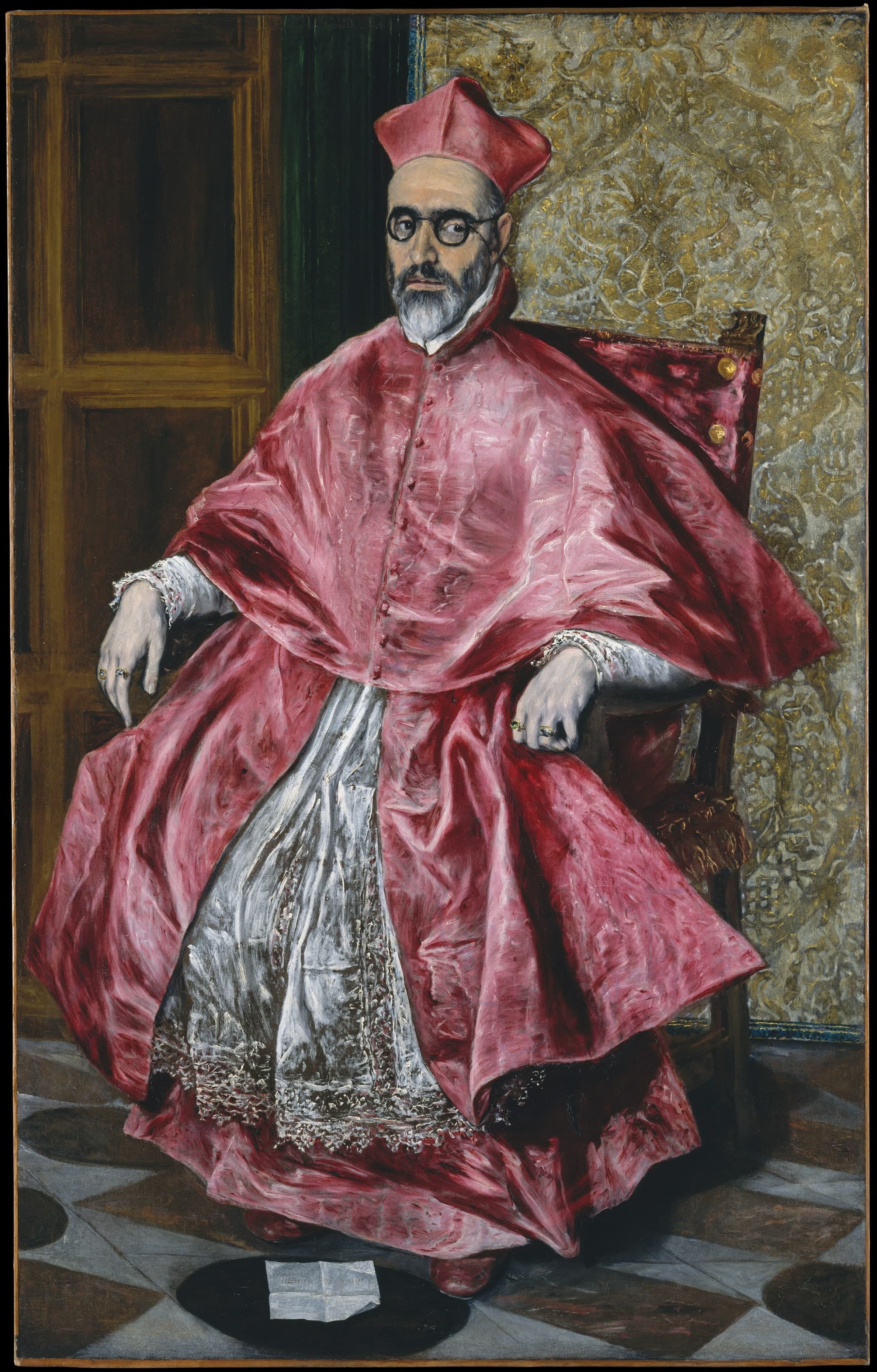
Cardinal Fernando Niño de Guevara
▶ Listen · narrated
El Greco painted this cardinal in oil on canvas in 1600. The sitter is known; the person who paid for the picture, and where it first hung, are not.
At a glance
- Date
- 1600
- Creator
- El Greco
- Material
- Oil paint on canvas
- Dimensions
- 171 × 108 cm (3 ft 7 in)
- Inventory
- 29.100.5
- Genre
- Portrait
Look closer
A portrait, not a type
The painting is catalogued as a portrait, not an allegory or a devotional scene. That classification matters. The canvas is sized for a single seated figure — 171 centimetres (5 ft 7 in) high by 108 wide — and the genre claim rests on the identification of the sitter as Cardinal Fernando Niño de Guevara, not on a symbolic programme. What we are looking at is a likeness made for a specific man, in a specific year, by a named painter.
Oil on canvas, at full height
The support is canvas; the medium is oil paint. At 171 centimetres (5 ft 7 in) in height the picture approaches the scale of a standing adult, even if the sitter is shown seated. That physical presence is part of how such portraits worked in Early Modern Spain: they occupied wall space in residences, chapels, or institutions, and they were meant to be met almost at eye level rather than studied as miniatures.
A name fixed to an object
The Metropolitan Museum of Art holds the painting under inventory number 29.100.5 and presents it as El Greco’s portrait of the cardinal. The link between canvas, artist, date and sitter is the firm ground. Almost everything beyond that — who ordered the work, where it first hung, how it travelled — sits in a thinner documentary layer and has to be argued rather than simply read off the surface.
The story
Cardinal Fernando Niño de Guevara is an oil painting on canvas made in 1600 by El Greco. It belongs to the Metropolitan Museum of Art in New York, where it is kept under the inventory number 29.100.5. The picture measures 171 centimetres (5 ft 7 in) in height and 108 in width. Those are the facts the museum and the public catalogue treat as secure: artist, date, medium, support, dimensions, genre, sitter and present location.
The sitter was Fernando Niño de Guevara, a Spanish churchman who had been named cardinal of San Martino ai Monti in 1596 and who, in 1599, was nominated and then promoted to Inquisitor General of Spain. The commission is generally placed in the spring of 1600, during a visit he made to Toledo that lasted several weeks. El Greco was working in that city. The meeting of a high church official and a painter already known for major commissions is the practical setting in which the portrait is thought to have been ordered.
Who actually paid for it is less clear. In an article on three paintings by El Greco, Walter Liedtke has argued that the more likely patron was not the cardinal himself but his nephew, Pedro Lasso, Conde de Los Arcos. Liedtke’s reasoning turns on Spanish habit as much as on documents. Outside court circles, commissioning a portrait of oneself was still something of a novelty; family members more often ordered likenesses of prominent kin. Pedro Lasso was already an established patron of El Greco and, at his death, is said to have owned seven or eight paintings by the artist, though it is not certain that this cardinal’s portrait was among them. He collected family portraits and images of public figures, including churchmen and royalty. On that reading, the canvas could have been a public gesture of family pride, hung in a residence, a family chapel, or an institution he supported — a way of showing both a powerful relative in the church and a fashionable painter’s hand.
Other relatives are harder to place as patrons. The cardinal’s sisters were in convents. His brother Rodrigo spent much of his life in the Spanish Netherlands and may not have been in Spain often enough to follow El Greco’s reputation closely. None of this amounts to a signed contract. It is a reconstruction from patterns of patronage and from what is known of the family’s movements.
The painting has also had a second life in fiction. Stefan Andres used the sitting as the centre of a 1936 novel. A 1947 film and a 2007 biographical film each invent scenes in which the cardinal and the painter confront one another before the Inquisition. Those stories are not evidence for the commission; they show how charged the combination of El Greco’s name and the office of Inquisitor General has remained for later writers.
What the canvas itself still offers is more restrained: a dated portrait by a major painter of a named Spanish cardinal, preserved at a scale that once filled a real wall, and still carrying an open question about who first wanted it made.
Why it mattered then
In 1600 a portrait of this kind did several kinds of work at once. For the sitter, or for the family that may have ordered it, it fixed a public identity at a moment of high office. Guevara had only recently become Inquisitor General; a large oil likeness by a painter already associated with royal and ecclesiastical commissions could mark that rank in rooms where visitors and dependents would see it. If Pedro Lasso was the patron, the picture also served family politics. Displaying a cardinal uncle painted by El Greco announced two forms of status: kinship with a senior churchman, and access to an artist who had worked for the crown. In a culture where self-commissioned portraits outside the court were still unusual, the nephew’s agency would have been as legible as the cardinal’s face. For El Greco the work sat inside an existing Toledo practice of serving noble and clerical clients. The spring visit of 1600 gave a short window in which sitter and painter could be in the same city. The resulting canvas is therefore both a record of a person and a product of a brief, well-timed encounter between office, family ambition and a local workshop.
Why it matters now
The painting still matters because it is one of the securely attributed El Greco portraits whose sitter can be named and dated, and because the uncertainty around its patronage is itself instructive. Museums and viewers often want a clean story: artist, subject, patron, room. Here the first two are firm and the last two are not. That gap forces a more careful kind of looking — one that separates what the object declares from what scholars infer. It also keeps alive a larger question about how power was pictured in Early Modern Spain. A cardinal who held the office of Inquisitor General is not a neutral subject. Later novels and films have filled the sitting with invented moral drama. The historical canvas does not stage a trial; it presents a likeness. Holding those two uses apart — the portrait as evidence of presence, and the portrait as a screen for later storytelling — is part of why the work remains useful in a museum gallery. Finally, at full size on a gallery wall, the picture still does what large formal portraits were built to do: it meets the viewer almost at human scale and asks to be read as a person in office, not as a small collectible image.
The surprising detail
The sitting has been rewritten more often than the commission has been proved. A 1936 novel, a 1947 film and a 2007 film all invent confrontations between El Greco and the cardinal as Inquisitor, including trial scenes that have no footing in the documentary record of the portrait. The art-historical argument, by contrast, is quieter and more tentative: Walter Liedtke’s case for Pedro Lasso as patron rests on patterns of Spanish self-fashioning and on Lasso’s known collecting, not on a surviving contract. The object that draws fictional drama is, in the scholarship, still partly an open file.
What is disputed
The identity of the patron is not settled. Walter Liedtke has argued that Pedro Lasso, Conde de Los Arcos and nephew of the sitter, is the more plausible commissioner, on the grounds that self-portrait commissions were still unusual outside court circles and that Lasso was an established El Greco patron who collected family and public likenesses. The cardinal’s other siblings are less likely candidates on present evidence, but no contract or early inventory entry has been produced to close the question. It is also unclear whether this portrait was among the seven or eight El Greco paintings Lasso is said to have owned at his death, and the painting’s original hanging place is unknown.
Remember this
A dated El Greco portrait of a named cardinal — secure as likeness and attribution, still unresolved as to who paid for it and where it first hung.
Test yourself
Why does the suggestion that Pedro Lasso commissioned the portrait matter even though no contract survives?
Because it changes what the painting was for. If the cardinal ordered his own likeness, the canvas is chiefly a record of personal office. If his nephew ordered it, the same face becomes a family claim — proof of kinship with a senior churchman and of access to a prestigious painter — and the first audience may have been visitors to a Lasso residence, chapel or favoured institution rather than the sitter’s private rooms. The hypothesis does not alter the attribution; it alters the social work the portrait was meant to do.