II · THE DISCOVERY · HISTORY OF SCIENCE
Neutron
The neutron completed the picture of what atoms are made from. More importantly, it gave physicists a tool: an uncharged particle that could slip into a nucleus and break it apart.
At a glance
- Discovered
- 1932, by James Chadwick
- Where
- Cavendish Laboratory Of Experimental Physics
- Symbol
- n or n⁰
- Charge
- None
- Mass
- Slightly greater than a proton
Look closer
The neutron has no charge, and that matters
A proton carries a positive electric charge, which means it is repelled by the positive charge of an atomic nucleus. A neutron carries no charge at all. That difference in behaviour is what made the neutron useful almost immediately: it could approach a nucleus without being pushed away, slip inside, and destabilise it. The discovery of nuclear fission followed within six years.
A neutron on its own decays
A neutron inside a stable nucleus stays there. A neutron on its own — called a free neutron — spontaneously decays into a proton, an electron, and an antineutrino. The mean lifetime is about fifteen minutes. That decay is what limits how neutrons can be stored and used: you cannot keep a bottle of them.
Neutrons are not elementary
The neutron is not a fundamental particle in the way an electron is. Each neutron is composed of three quarks, which are the actual elementary components. That structure was not known in 1932; it emerged from later work in particle physics. The discovery Chadwick made was of the neutron as a distinct, observable particle with measurable properties, not of its internal composition.
The story
A neutron is a subatomic particle with no electric charge and a mass slightly greater than that of a proton. It sits, together with protons, in the nucleus of an atom. The number of neutrons in a nucleus can vary even when the number of protons stays the same — atoms of the same element that differ only in neutron number are called isotopes.
James Chadwick discovered the neutron in 1932 at the Cavendish Laboratory Of Experimental Physics. Before that discovery, physicists knew atoms had a nucleus and that the nucleus contained protons, but the mass did not add up: nuclei were heavier than their protons alone could account for. The neutron solved that problem. It also introduced a new tool, because a particle with no charge behaves differently from one that has charge.
A proton carries a positive charge, so when it approaches an atomic nucleus — which is also positively charged — it is repelled. A neutron, having no charge, is not. That means a neutron can approach a nucleus, enter it, and change it. Within six years of Chadwick's discovery, researchers had used neutrons to achieve nuclear fission — the splitting of a heavy nucleus into lighter ones, releasing energy. Within ten years of that, the knowledge had led to a self-sustaining nuclear reactor, and within another three years, to a nuclear weapon.
Free neutrons — neutrons not bound inside a nucleus — are produced in large numbers during nuclear fission and fusion. A free neutron does not last: it decays spontaneously into a proton, an electron, and an antineutrino, with a mean lifetime of about fifteen minutes. That decay sets a practical limit on what can be done with free neutrons outside a reactor or an experiment.
Neutrons are also produced in stars, where they contribute to nucleosynthesis — the formation of heavier chemical elements from lighter ones through processes including fission, fusion, and neutron capture. Neutron stars, formed from massive collapsing stars, consist of neutrons at the density of atomic nuclei but with a total mass more than the Sun.
A small natural flux of free neutrons exists on Earth, caused by cosmic rays and by the natural radioactivity of spontaneously fissionable elements in the Earth's crust. Free neutrons do not directly ionise atoms, but they do indirectly cause ionising radiation, so they can be a biological hazard, depending on dose. Dedicated neutron sources — neutron generators, research reactors and spallation sources — produce free neutrons for use in irradiation and in neutron scattering experiments.
Why it mattered then
Before 1932, physicists had a problem: atomic nuclei were heavier than their protons could account for. The neutron solved it. It also gave researchers a particle that could enter a nucleus without being repelled by its charge, which meant nuclei could be changed deliberately. Nuclear fission — the splitting of a heavy nucleus into lighter ones, releasing energy — was discovered within six years. A self-sustaining nuclear reactor, Chicago Pile-1, was built within ten years of that. The neutron made nuclear power and nuclear weapons possible, not because it was exotic, but because it was the right tool: uncharged, heavy enough to destabilise a nucleus, and produced copiously when fission occurs.
Why it matters now
The neutron is essential to the production of nuclear power. Reactors work by sustaining a chain reaction in which neutrons released by one fission event go on to cause others. Neutrons are also used in research: dedicated neutron sources produce free neutrons for irradiation and for neutron scattering experiments, which reveal the structure of materials. The neutron remains a tool in physics and engineering, not just a component of matter. Its behaviour — uncharged, able to penetrate nuclei, unstable when free — determines what can be done with it.
The surprising detail
A neutron on its own has a mean lifetime of about fifteen minutes. Inside a stable nucleus, it stays indefinitely. That difference is not a quirk: it reflects the balance of forces inside the nucleus, where protons and neutrons are bound together. A free neutron decays into a proton, an electron, and an antineutrino because that decay is energetically favourable when the neutron is alone. The same decay cannot happen inside a nucleus where the energy balance is different. The neutron is stable or unstable depending on where it is.
What is disputed
The reference material states that nuclear fission was discovered in 1938, six years after the neutron, and that Chicago Pile-1 was built in 1942, ten years after that. The arithmetic here crosses the verified discovery date of 1932 with dates not in the verified facts, so the lesson hedges: it says fission followed within six years and the reactor within ten years of fission, without stating those later dates as verified.
Remember this
The neutron completed the atomic nucleus and gave physicists a tool to change it. Uncharged, it could slip inside and split atoms.
Test yourself
Why did the neutron make nuclear fission possible so quickly after its discovery, when the proton had been known for years without leading to the same result?
A proton carries a positive charge, so it is repelled by the positive charge of an atomic nucleus. That repulsion makes it difficult to get a proton close enough to a nucleus to interact with it. A neutron has no charge, so it is not repelled. It can approach a nucleus, enter it, and destabilise it. That difference in behaviour is why neutrons became the tool for inducing fission within six years of their discovery, while protons, known much earlier, did not lead to the same breakthrough.
Go deeper
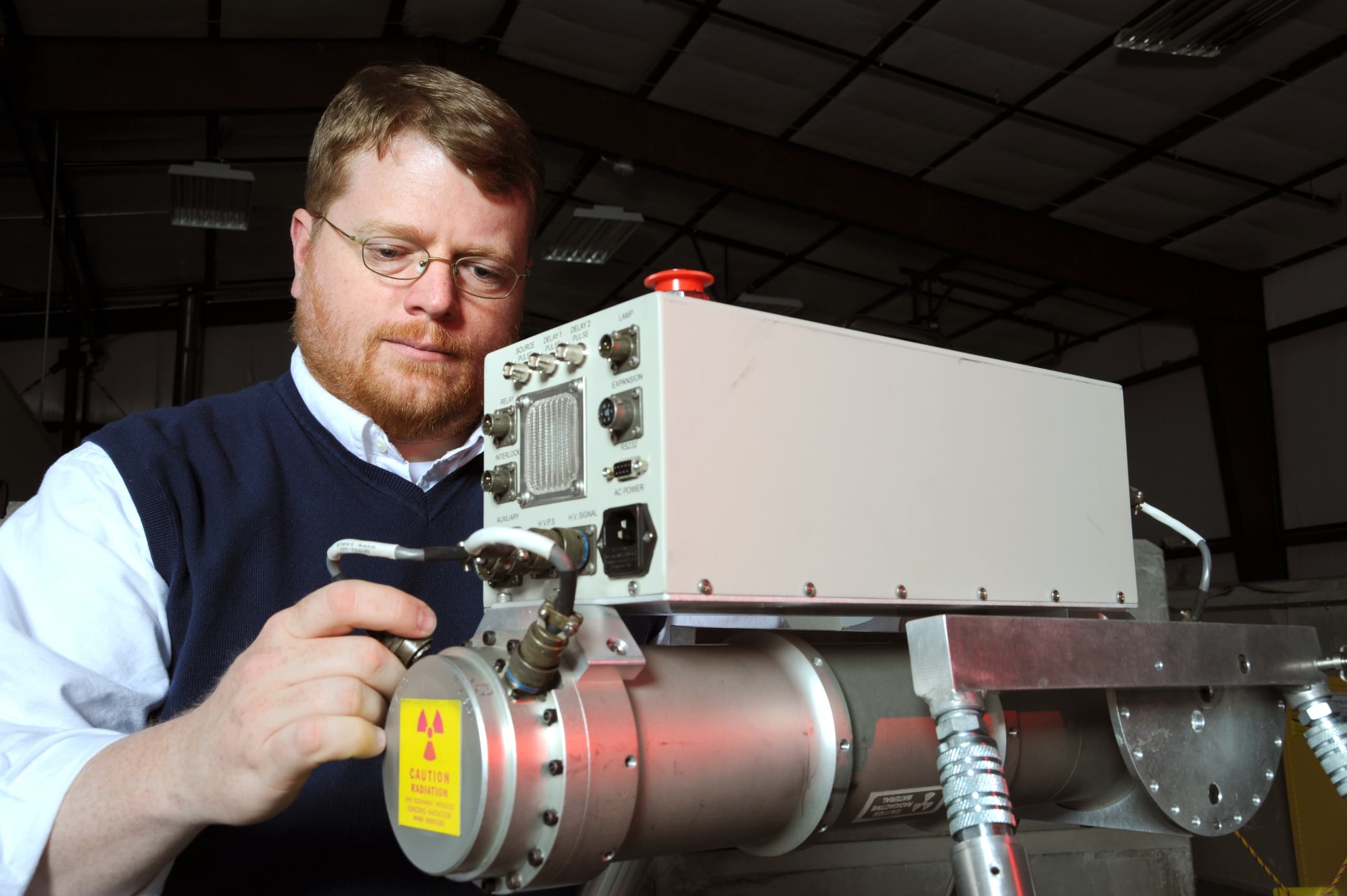
Image: Idaho National Laboratory, CC BY 2.0. Licence: CC BY 2.0. Source.