II · THE DISCOVERY · HISTORY OF SCIENCE
Transistor
Before the transistor, amplifying a signal meant a glass tube, a heater, and substantial power. The transistor did the same work with a sliver of semiconductor and almost no heat.
At a glance
- Type
- Electronic component
- Discovered
- December 1947
- Discoverers
- John Bardeen, Walter Brattain, William Shockley
- Institution
- Bell Labs
- Recognition
- 1956 Nobel Prize in Physics, shared by all three
Look closer
Three terminals, not two
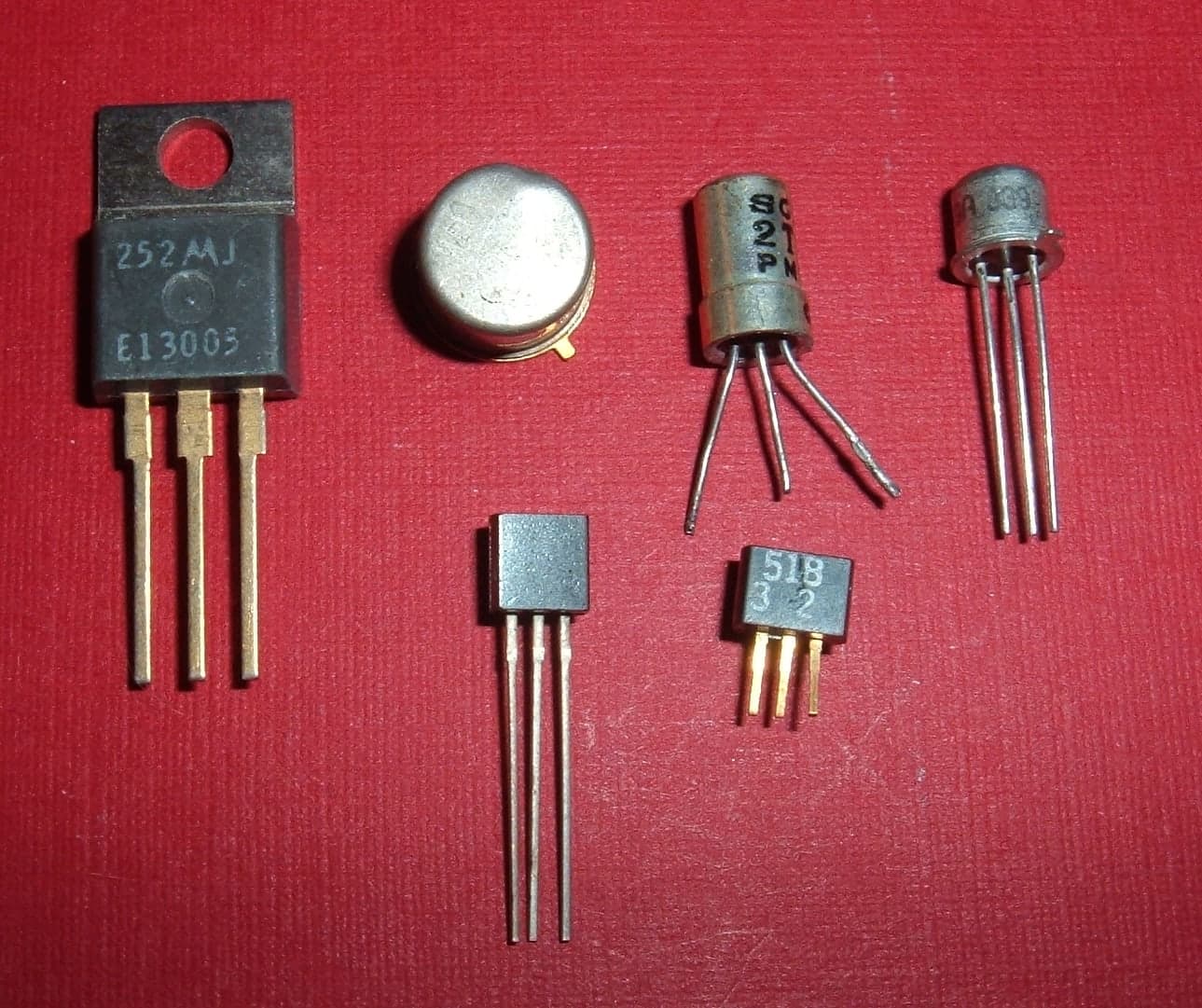
A transistor has at least three terminals for connection to a circuit. A voltage or current applied to one pair of the terminals controls the current through another pair. That arrangement is what makes amplification possible: the controlled output power can be higher than the controlling input power, so a small signal at the input can produce a large signal at the output.
The concept preceded the working device
Physicist Julius Edgar Lilienfeld proposed the concept of a field-effect transistor in 1925, but it was not possible to construct a working device at that time. The gap between the idea and the working transistor that Bardeen, Brattain and Shockley built in December 1947 was substantial, and the device they built was a point-contact transistor, a different design from the one Lilienfeld had described.
Semiconductor material, very pure
Most transistors are made from very pure silicon, and some from germanium. The purity matters because a transistor relies on controlling the movement of charge carriers — electrons or holes — through the material, and impurities interfere with that control. Some transistors use only one kind of charge carrier; others, called bipolar junction transistors, use both.
The story
A transistor is a semiconductor device that amplifies or switches electrical signals. The working principle is this: a voltage or current applied to one pair of the transistor's terminals controls the current through another pair. Because the controlled output power can be higher than the controlling input power, a transistor can amplify a signal — a small input produces a large output.
The device has at least three terminals for connection to an electronic circuit. That three-terminal arrangement is central to how it works: one pair of terminals receives the input signal, another pair delivers the output, and the input controls the output without the two being directly connected.
Physicist Julius Edgar Lilienfeld proposed the concept of a field-effect transistor in 1925, but it was not possible to construct a working device at that time. The working transistor that Bardeen, Brattain and Shockley built in December 1947 at Bell Labs was a point-contact transistor, a different design from the one Lilienfeld had described.
The three physicists shared the 1956 Nobel Prize in Physics for their achievement. The point-contact transistor was not the end of the development. Between 1955 and 1960, also at Bell Labs, researchers developed the metal–oxide–semiconductor field-effect transistor, or MOSFET, which became the most widely used type.
Most transistors are made from very pure silicon, and some from germanium. The purity is necessary because the device relies on controlling the movement of charge carriers — electrons or holes — through the semiconductor material, and impurities interfere with that control. Some transistors, called field-effect transistors, use only one kind of charge carrier. Others, called bipolar junction transistors, use both.
Compared with the vacuum tube, which did similar work before the transistor, transistors are generally smaller and require less power to operate. Certain vacuum tubes retain advantages over transistors at very high operating frequencies or high operating voltages, such as travelling-wave tubes and gyrotrons, but for most purposes the transistor replaced the tube. Many types of transistors are made to standardised specifications by multiple manufacturers.
Why it mattered then
Before the transistor, amplifying an electrical signal or switching it on and off required a vacuum tube: a glass envelope with a heated filament, a metal plate, and often a grid in between. The tube worked, but it needed power to heat the filament, it generated heat, it was fragile, and it took up space. The transistor did the same work with a piece of semiconductor material, usually silicon or germanium, and three terminals. It required far less power, generated far less heat, and was much smaller. That difference made new kinds of devices possible almost immediately. Radios could be portable without heavy batteries. Amplifiers could be built into equipment that had no room for tubes. The point-contact transistor that Bardeen, Brattain and Shockley built in December 1947 was not the end of the development. Other designs followed, including the MOSFET developed at Bell Labs between 1955 and 1960, which became the dominant type. But the working device in 1947 was the proof that a semiconductor could do what a vacuum tube did, and do it better for most purposes.
Why it matters now
Transistors are the key active components in practically all modern electronics. They are found individually in some applications, but far more commonly they are embedded in integrated circuits — chips — where millions or billions of transistors work together. Every computer processor, every memory chip, every smartphone, every digital device relies on transistors to amplify signals, to switch them on and off, and to perform the logic operations that underpin computation. The MOSFET, developed between 1955 and 1960, is the type used in most integrated circuits. The transistor made electronics smaller, cheaper, and more reliable. It made possible the pocket radio, the pocket calculator, and eventually the pocket computer. It is the building block that allowed the field of electronics to move from devices with dozens of components to devices with billions, all on a chip smaller than a fingernail. Without the transistor, the digital age as we know it would not exist. The device that three physicists built at Bell Labs in December 1947, and the designs that followed it, are the foundation of the technology we use every day.
The surprising detail
The Nobel Prize in 1956 went to all three physicists — Bardeen, Brattain and Shockley — but the working relationships among them were not smooth. Shockley, who led the group, was not in the room when Bardeen and Brattain built the point-contact transistor in December 1947. He developed a different design, the junction transistor, shortly after, and that design proved more practical for manufacturing. The prize recognised the achievement, but the credit was shared among three people whose collaboration was more complicated than the shared award suggests.
What is disputed
The verified date is December 1947, without a specific day. The reference text describes the device as invented in 1947 and credits Bardeen, Brattain and Shockley equally, which matches the shared Nobel Prize in 1956. The text also notes that Lilienfeld proposed a field-effect transistor in 1925 but could not build one, and that the 1947 device was a point-contact transistor, a different design. The relationship between the concept, the working device, and the later MOSFET is a sequence of different designs rather than a single invention, but the 1947 point-contact transistor is what the discovery date refers to.
Remember this
The transistor replaced the vacuum tube with a semiconductor, making electronics smaller, cheaper, and more reliable.
Test yourself
A transistor has at least three terminals, not two. Why does that matter for what the device can do?
The three-terminal arrangement is what allows a transistor to amplify a signal. A voltage or current applied to one pair of terminals controls the current through another pair. Because the controlled output power can be higher than the controlling input power, a small input signal can produce a large output signal. With only two terminals, you could switch a current on or off, but you could not use a small signal to control a large one — which is what amplification means.
Go deeper
Image: ArnoldReinhold, CC BY-SA 3.0. Licence: CC BY-SA 3.0. Source.